Telophase is the final stage of mitosis. It begins when the separated chromatids, now called chromosomes, arrive at opposite poles of the cell at the end of anaphase.In telophase the events of prophase are essentially reversed:
• a new nuclear envelope forms around each group of chromosomes, giving two nuclei;
• the nucleolus reappears in each new nucleus;
• the chromosomes uncoil and become long, thin chromatin again, so they can no longer be seen with a light microscope;
• the spindle fibres break down.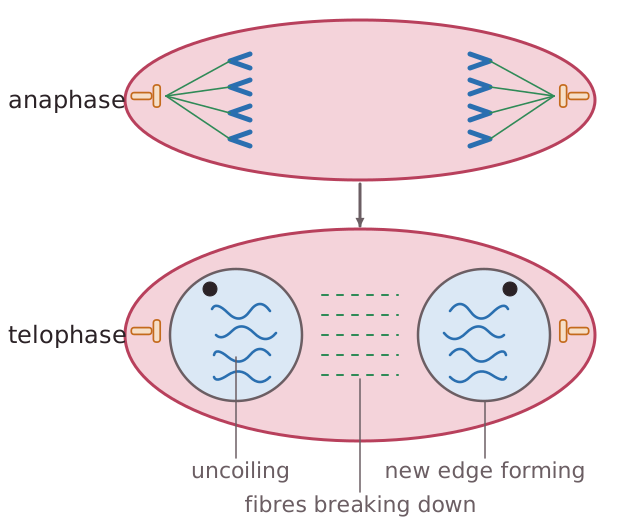 Each new nucleus contains the same number of chromosomes as the parent nucleus, and each chromosome is now a single (unreplicated) DNA molecule. For example, a human cell ends telophase with two nuclei, each holding 46 chromosomes. The two nuclei are genetically identical to each other and to the original nucleus, because each chromatid was an exact copy made by semi-conservative DNA replication in interphase.Uncoiling the chromosomes matters because genes in tightly packed DNA cannot easily be transcribed. Once the DNA is back in the form of chromatin, the cells can transcribe their genes again, make proteins and grow during the G1 phase that follows.Telophase marks the end of nuclear division. Division of the cytoplasm (cytokinesis) often starts towards the end of telophase, but it is a separate process. Under a microscope, a cell in telophase shows two compact groups of chromosomes at opposite ends of the cell.
• a new nuclear envelope forms around each group of chromosomes, giving two nuclei;
• the nucleolus reappears in each new nucleus;
• the chromosomes uncoil and become long, thin chromatin again, so they can no longer be seen with a light microscope;
• the spindle fibres break down.
Each new nucleus contains the same number of chromosomes as the parent nucleus, and each chromosome is now a single (unreplicated) DNA molecule. For example, a human cell ends telophase with two nuclei, each holding 46 chromosomes. The two nuclei are genetically identical to each other and to the original nucleus, because each chromatid was an exact copy made by semi-conservative DNA replication in interphase.Uncoiling the chromosomes matters because genes in tightly packed DNA cannot easily be transcribed. Once the DNA is back in the form of chromatin, the cells can transcribe their genes again, make proteins and grow during the G1 phase that follows.Telophase marks the end of nuclear division. Division of the cytoplasm (cytokinesis) often starts towards the end of telophase, but it is a separate process. Under a microscope, a cell in telophase shows two compact groups of chromosomes at opposite ends of the cell.