Metaphase is the second stage of mitosis, following prophase. By this stage the nuclear envelope has broken down and the spindle is fully formed.The main events of metaphase are:• Spindle fibres attach to the centromeres. Each chromosome is attached at its centromere, and the two sister chromatids are attached to spindle fibres from opposite poles.
• Chromosomes line up on the equator. The spindle fibres pull the chromosomes into a single line across the middle of the cell, called the equator (or metaphase plate). Each chromosome lies separately; they are not in homologous pairs.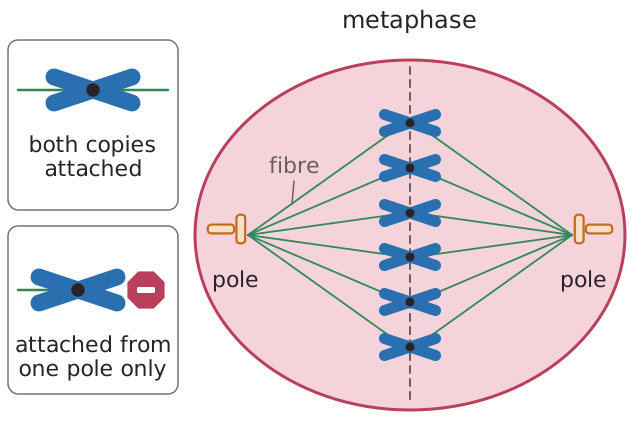 At the end of metaphase the spindle checkpoint operates: the cell checks that every chromosome is correctly attached to the spindle. Only then does anaphase begin. This makes sure that each daughter cell will receive one copy of every chromosome.Metaphase is the easiest stage to recognise in a micrograph: look for chromosomes arranged in a line across the centre of the cell, with the spindle fibres running from pole to pole.Because the chromosomes are at their most condensed and are clearly separated, metaphase is the best stage for counting chromosomes and examining their shape. A karyotype is prepared from cells in metaphase. Scientists can stop cells in metaphase by treating them with a chemical such as colchicine, which prevents spindle fibres working, so the cells cannot move into anaphase.
• Chromosomes line up on the equator. The spindle fibres pull the chromosomes into a single line across the middle of the cell, called the equator (or metaphase plate). Each chromosome lies separately; they are not in homologous pairs.
At the end of metaphase the spindle checkpoint operates: the cell checks that every chromosome is correctly attached to the spindle. Only then does anaphase begin. This makes sure that each daughter cell will receive one copy of every chromosome.Metaphase is the easiest stage to recognise in a micrograph: look for chromosomes arranged in a line across the centre of the cell, with the spindle fibres running from pole to pole.Because the chromosomes are at their most condensed and are clearly separated, metaphase is the best stage for counting chromosomes and examining their shape. A karyotype is prepared from cells in metaphase. Scientists can stop cells in metaphase by treating them with a chemical such as colchicine, which prevents spindle fibres working, so the cells cannot move into anaphase.