Cytokinesis is the division of the cytoplasm to form two separate daughter cells. It follows nuclear division (mitosis) and usually begins during late telophase. Mitosis divides the nucleus; cytokinesis divides the rest of the cell.In animal cells, a ring of protein filaments (actin and myosin) just beneath the cell surface membrane contracts around the equator of the cell. This pulls the membrane inwards to form a cleavage furrow, which deepens until the membrane pinches apart, giving two cells.In plant cells a furrow cannot form because the cell wall is rigid. Instead, vesicles from the Golgi apparatus collect along the equator, where the spindle was, and fuse to form a cell plate. The vesicle membranes become the new cell surface membranes, and the material inside the vesicles builds the middle lamella and new cell walls between the two daughter cells.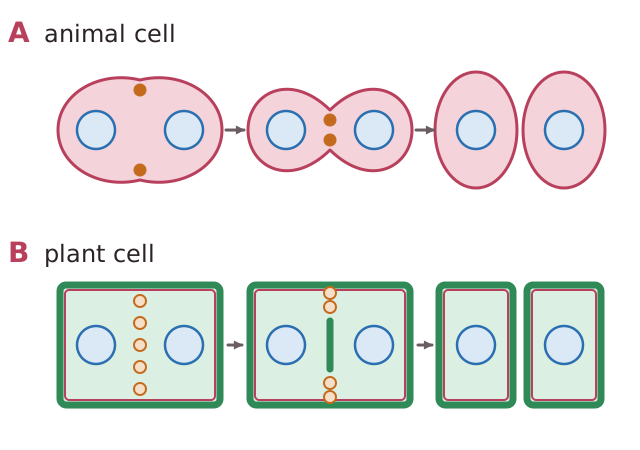 Organelles such as mitochondria and chloroplasts are shared out between the daughter cells, and they later divide to increase their numbers.Each daughter cell receives one of the two identical nuclei, so the daughter cells are genetically identical to each other and to the parent cell. They are smaller than the parent cell and enter the G1 phase of interphase, where they grow before the next cycle.Worked example: a parent cell with 46 chromosomes completes mitosis and cytokinesis. The result is two cells, each with 46 chromosomes.