Anaphase is the third stage of mitosis, following metaphase. At the end of metaphase each chromosome, made of two identical sister chromatids joined at the centromere, is lined up on the equator of the spindle with spindle fibres attached to its centromere.At the start of anaphase the centromeres divide, so the two sister chromatids of each chromosome separate. From this point each chromatid is treated as a separate daughter chromosome.The spindle fibres attached to the centromeres shorten, pulling the chromatids towards opposite poles of the cell. The centromere leads, so the arms of each chromatid trail behind, giving the characteristic V shape seen under the microscope. The energy for this movement comes from ATP, supplied by respiration in mitochondria.
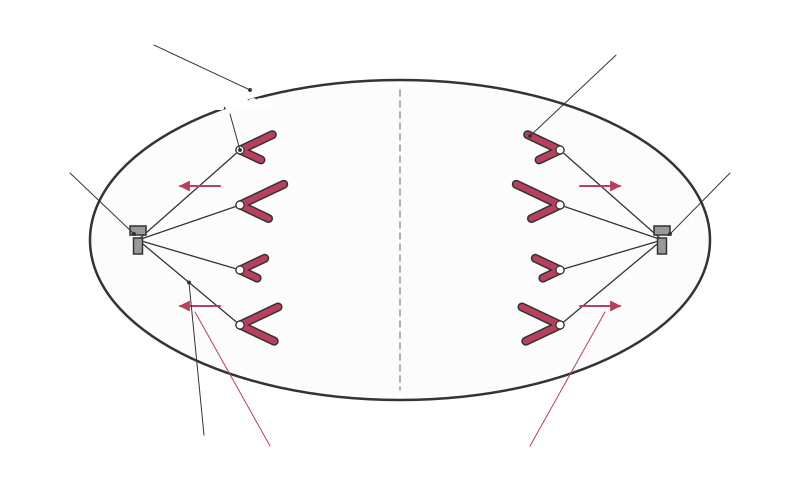
Because the two chromatids of each chromosome are genetically identical copies made by DNA replication during interphase, each pole receives one complete set of chromosomes, identical to the set at the other pole. In a human cell, 46 chromatids move to each pole.Anaphase is quick compared with the other stages of mitosis. It ends when the separated chromatids have reached the poles, and telophase begins.A drug that stops spindle fibres forming, such as colchicine, stops cells at metaphase, because without spindle fibres the chromatids cannot be pulled apart.
Read the text
Read the text and highlight anything you think is important. When you go on, the text is hidden and you answer from memory.
Specification: Edexcel Biology B (8BI0), AS-level, 2.3 Eukaryotic cell cycle and division. Topic: The Cell Cycle.
Key terms in this lesson
- centromere
- The region of a chromosome that joins sister chromatids together and to which spindle fibres attach during cell division.
- telophase
- The final stage of mitosis, in which chromosomes arrive at the poles, uncoil, and a new nuclear envelope forms around each set.
More in The Cell Cycle
- Control of the Cell Cycle
- Mitosis
- Prophase
- Metaphase
- Telophase
- Cytokinesis
- Asexual Reproduction
- Sporulation
All 18 lessons in The Cell Cycle · All Edexcel AS-level Biology topics