The cell cycle is tightly controlled so that a cell only divides when it should, and only when it is ready. Control happens at checkpoints, points in the cycle where the cell checks conditions before moving to the next stage.• G1 checkpoint (at the end of G1): checks that the cell is large enough, that there are enough nutrients, that growth factors are present and that the DNA is not damaged. If conditions are not met, the cell may enter G0.
• G2 checkpoint (at the end of G2): checks that all the DNA has been replicated correctly and without damage before mitosis begins.
• Spindle checkpoint (during metaphase of mitosis): checks that every chromosome is attached to the spindle before the chromatids are pulled apart.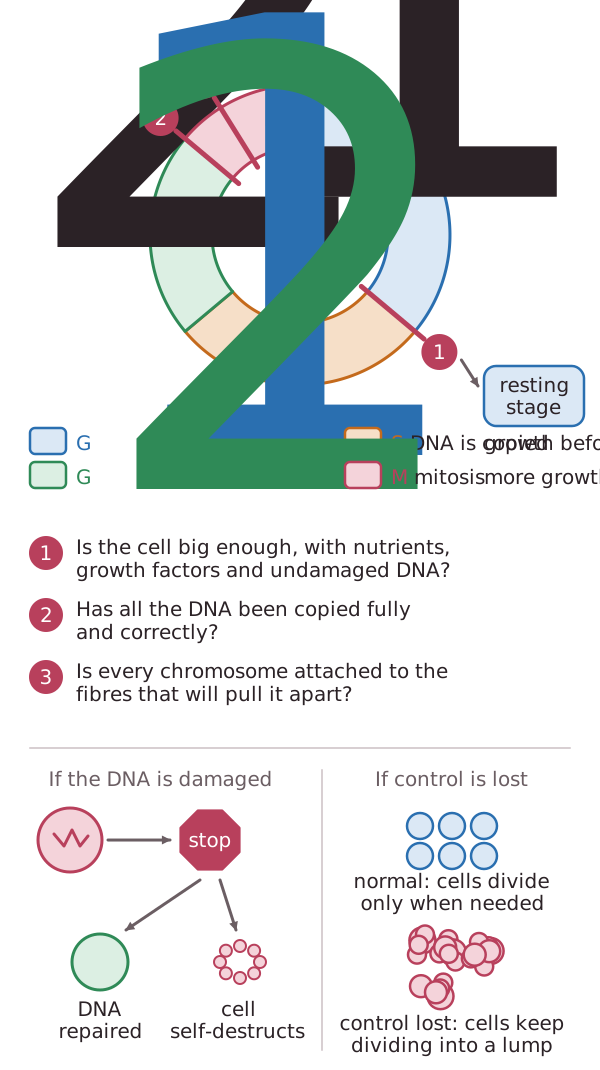 Progress through the checkpoints is driven by proteins called cyclins, whose levels rise and fall during the cycle. Cyclins bind to and activate enzymes called cyclin-dependent kinases (CDKs). An active cyclin-CDK complex phosphorylates other proteins, which triggers the next stage of the cycle.If DNA is damaged, proteins such as p53 stop the cycle so the damage can be repaired. If it cannot be repaired, the cell is made to destroy itself by apoptosis (programmed cell death).Genes that promote cell division are called proto-oncogenes, and genes that slow it down, such as the gene for p53, are tumour suppressor genes. Mutations in these genes can remove control of the cycle. The cell then divides repeatedly and uncontrollably, forming a tumour; this is how cancer develops.
• G2 checkpoint (at the end of G2): checks that all the DNA has been replicated correctly and without damage before mitosis begins.
• Spindle checkpoint (during metaphase of mitosis): checks that every chromosome is attached to the spindle before the chromatids are pulled apart.
Progress through the checkpoints is driven by proteins called cyclins, whose levels rise and fall during the cycle. Cyclins bind to and activate enzymes called cyclin-dependent kinases (CDKs). An active cyclin-CDK complex phosphorylates other proteins, which triggers the next stage of the cycle.If DNA is damaged, proteins such as p53 stop the cycle so the damage can be repaired. If it cannot be repaired, the cell is made to destroy itself by apoptosis (programmed cell death).Genes that promote cell division are called proto-oncogenes, and genes that slow it down, such as the gene for p53, are tumour suppressor genes. Mutations in these genes can remove control of the cycle. The cell then divides repeatedly and uncontrollably, forming a tumour; this is how cancer develops.