The gills of a bony fish are a highly folded exchange surface with a structure built for fast diffusion.• On each side of the head there are usually four gill arches, bony supports that also carry the main blood vessels.
• Each gill arch carries two rows of thin, flat gill filaments (primary lamellae).
• The upper and lower surfaces of each filament are covered in many tiny folds called gill lamellae (secondary lamellae), which lie at right angles to the filament. The lamellae are the actual site of gas exchange.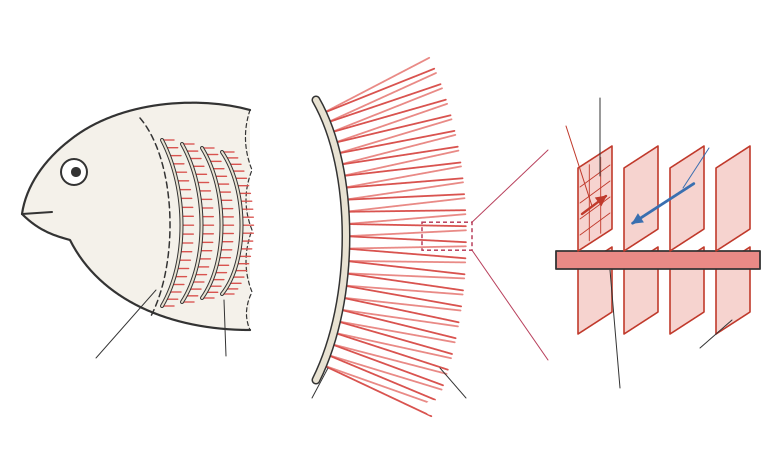
• a thin epithelium, only one or two cells thick, so the diffusion distance between water and blood is short
• a dense network of capillaries in each lamella, so blood constantly carries oxygen away and brings carbon dioxide, maintaining the concentration gradient
• blood in the lamellae flows in the opposite direction to the water passing over themThe filaments of neighbouring arches overlap slightly at their tips. This increases resistance to water flow, which slows the water down and gives more time for gas exchange.The gill filaments are held apart by the water flowing between them. In air there is nothing to support them, so they collapse and stick together, greatly reducing the surface area. This is why fish cannot breathe out of water even though air contains more oxygen.
• Each gill arch carries two rows of thin, flat gill filaments (primary lamellae).
• The upper and lower surfaces of each filament are covered in many tiny folds called gill lamellae (secondary lamellae), which lie at right angles to the filament. The lamellae are the actual site of gas exchange.
• a thin epithelium, only one or two cells thick, so the diffusion distance between water and blood is short
• a dense network of capillaries in each lamella, so blood constantly carries oxygen away and brings carbon dioxide, maintaining the concentration gradient
• blood in the lamellae flows in the opposite direction to the water passing over themThe filaments of neighbouring arches overlap slightly at their tips. This increases resistance to water flow, which slows the water down and gives more time for gas exchange.The gill filaments are held apart by the water flowing between them. In air there is nothing to support them, so they collapse and stick together, greatly reducing the surface area. This is why fish cannot breathe out of water even though air contains more oxygen.