Plants, like animals, respire all the time, so their cells need a constant supply of oxygen and must remove carbon dioxide. Photosynthesising cells also need carbon dioxide and produce oxygen. The net exchange of gases depends on the balance between these two processes:• in bright light, the rate of photosynthesis is greater than the rate of respiration, so a leaf takes in carbon dioxide and gives out oxygen
• in the dark, only respiration occurs, so the leaf takes in oxygen and gives out carbon dioxide
• at the compensation point, the rates of photosynthesis and respiration are equal, so there is no net exchange of either gasPlants have no ventilation mechanism and no specialised transport system for gases. All gas movement is by diffusion. This works because plants have a relatively low metabolic rate and because every living cell is close to air.The leaf is the main gas exchange organ and is well adapted:• it is thin and flat, giving a large surface area and a short diffusion distance
• the spongy mesophyll has many air spaces, so gases diffuse quickly through air right up to the mesophyll cells
• the mesophyll cells have a large, moist surface, and gases dissolve in this water film before diffusing into the cells
• gases enter and leave through pores in the epidermis called stomata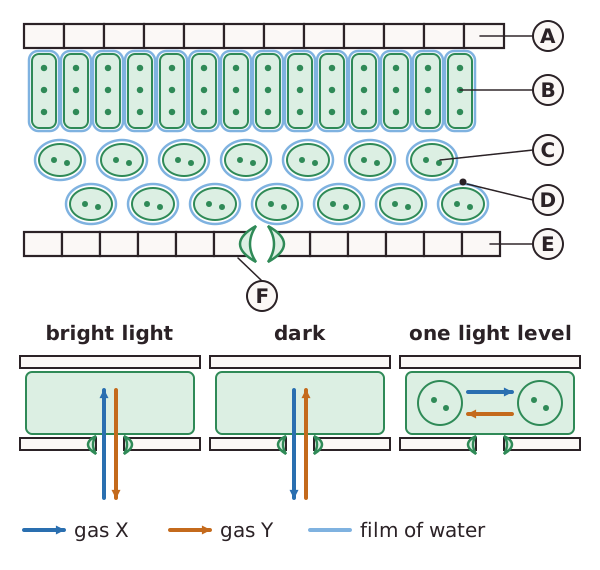 Gases diffuse down concentration gradients kept steep by the cells' own use of them. For example, in light, photosynthesis uses carbon dioxide, keeping its concentration in the air spaces lower than in the atmosphere.
• in the dark, only respiration occurs, so the leaf takes in oxygen and gives out carbon dioxide
• at the compensation point, the rates of photosynthesis and respiration are equal, so there is no net exchange of either gasPlants have no ventilation mechanism and no specialised transport system for gases. All gas movement is by diffusion. This works because plants have a relatively low metabolic rate and because every living cell is close to air.The leaf is the main gas exchange organ and is well adapted:• it is thin and flat, giving a large surface area and a short diffusion distance
• the spongy mesophyll has many air spaces, so gases diffuse quickly through air right up to the mesophyll cells
• the mesophyll cells have a large, moist surface, and gases dissolve in this water film before diffusing into the cells
• gases enter and leave through pores in the epidermis called stomata
Gases diffuse down concentration gradients kept steep by the cells' own use of them. For example, in light, photosynthesis uses carbon dioxide, keeping its concentration in the air spaces lower than in the atmosphere.