To keep a steep concentration gradient at the gills, a bony fish must keep a continuous, one-way flow of water over them, even when it is not swimming. It does this by changing the volumes, and so the pressures, of two cavities: the buccal cavity (mouth cavity) and the opercular cavity (the chamber containing the gills). Water, like air, flows from higher to lower pressure.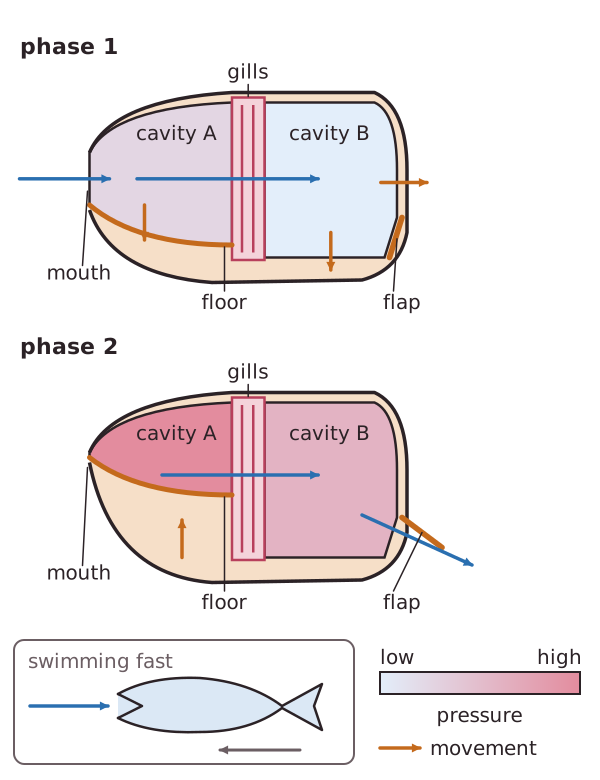 Taking water in
• The mouth opens and the floor of the buccal cavity is lowered.
• The volume of the buccal cavity increases, so its pressure decreases and water flows in through the mouth.
• At the same time the operculum is closed and the opercular cavity expands, lowering its pressure so water is drawn from the buccal cavity over the gills.Forcing water out
• The mouth closes and the floor of the buccal cavity is raised.
• The volume decreases and the pressure increases, forcing water over the gills into the opercular cavity.
• The pressure in the opercular cavity rises, the operculum opens and water leaves through the opercular opening.Because the pressure in the buccal cavity is kept higher than that in the opercular cavity for almost the whole cycle, water flows over the gills nearly continuously and always in the same direction.Some fast-swimming fish, such as tuna and many sharks, use ram ventilation: they swim with their mouths open so that forward movement forces water over the gills. Many of these fish must keep swimming to breathe.
Taking water in• The mouth opens and the floor of the buccal cavity is lowered.
• The volume of the buccal cavity increases, so its pressure decreases and water flows in through the mouth.
• At the same time the operculum is closed and the opercular cavity expands, lowering its pressure so water is drawn from the buccal cavity over the gills.Forcing water out
• The mouth closes and the floor of the buccal cavity is raised.
• The volume decreases and the pressure increases, forcing water over the gills into the opercular cavity.
• The pressure in the opercular cavity rises, the operculum opens and water leaves through the opercular opening.Because the pressure in the buccal cavity is kept higher than that in the opercular cavity for almost the whole cycle, water flows over the gills nearly continuously and always in the same direction.Some fast-swimming fish, such as tuna and many sharks, use ram ventilation: they swim with their mouths open so that forward movement forces water over the gills. Many of these fish must keep swimming to breathe.