 BRAINCAKE
Lock and Key Hypothesis
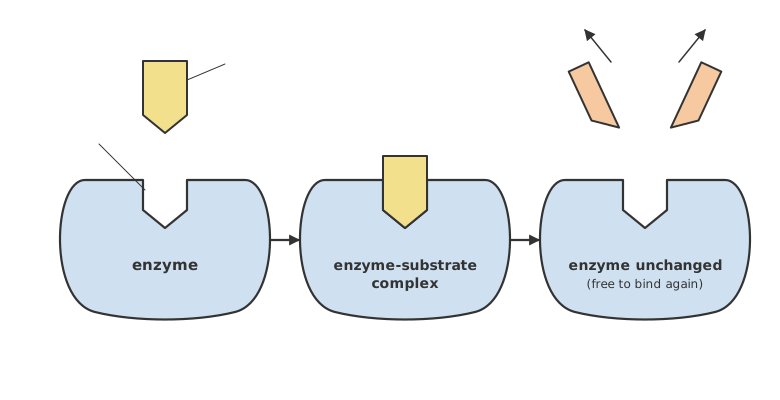
The lock and key hypothesis was proposed by Emil Fischer in 1894 to explain how enzymes work and why they are specific.
In this model:
• the active site has a fixed, rigid shape
• only a substrate with a shape exactly complementary to the active site can fit into it, just as only the right key fits a lock
• when the substrate fits, an enzyme-substrate complex forms
• the reaction happens and an enzyme-product complex forms
• the products no longer fit, so they are released, leaving the enzyme unchanged and free to bind another substrate
Sign in free to see the rest of this lesson, the R.E.C.I.P.E. recall steps and the quiz
BrainCake is free. Make an account in seconds and pick up where this page stops.
Key terms in this lesson
- active site
- The region of an enzyme, with a shape complementary to its substrate, where the substrate molecule binds and the reaction is catalysed.
- enzyme-substrate complex
- A temporary structure formed when a substrate molecule binds to the active site of an enzyme.
More in Enzymes
- Enzymes
- Extra-Cellular and Intracellular Enzymes
- Biological Catalysts
- Induced Fit Hypothesis
- Measuring Rate of Reaction
- Effect of Substrate Concentration
- Effect of Temperature
- Effect of pH
All 14 lessons in Enzymes · All Edexcel AS-level Biology topics