 BRAINCAKE
Effect of Temperature
Temperature affects enzyme activity in two opposing ways.
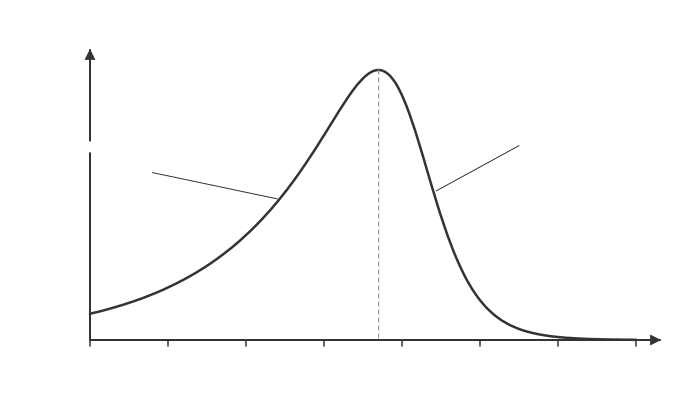
Up to the optimum: raising the temperature gives the enzyme and substrate molecules more kinetic energy. They move faster and collide more often, so more enzyme-substrate complexes form per second and the rate increases. For many reactions the rate roughly doubles for every 10 °C rise.
Sign in free to see the rest of this lesson, the R.E.C.I.P.E. recall steps and the quiz
BrainCake is free. Make an account in seconds and pick up where this page stops.
Key terms in this lesson
- denaturation
- A permanent change to the tertiary or secondary structure of a protein, caused by heat or extreme pH, that destroys its shape and function.
- kinetic energy
- The energy a particle has because of its motion; raising temperature increases the kinetic energy of molecules.
More in Enzymes
- Lock and Key Hypothesis
- Induced Fit Hypothesis
- Measuring Rate of Reaction
- Effect of Substrate Concentration
- Effect of pH
- Effect of Enzyme Concentration
- Reversible and Irreversible Inhibition
- Competitive Inhibition
All 14 lessons in Enzymes · All Edexcel AS-level Biology topics