 BRAINCAKE
Effect of Substrate Concentration
When enzyme concentration and all other conditions are kept constant, changing the substrate concentration gives a characteristic curve.
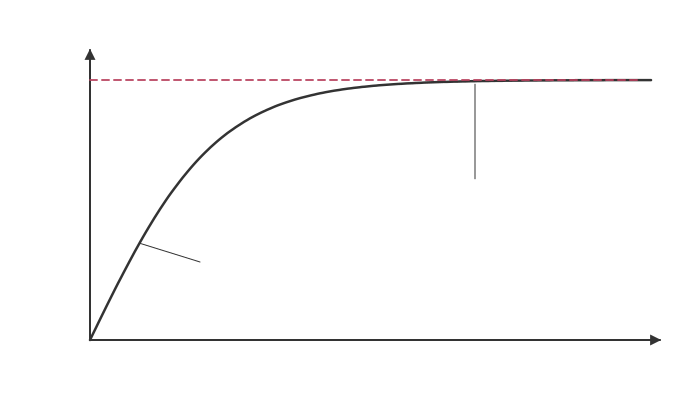
At low substrate concentrations, increasing substrate concentration increases the rate. There are more substrate molecules, so there are more successful collisions with active sites and more enzyme-substrate complexes form per second. Many active sites are empty, so substrate concentration is the limiting factor. In this region the rate is roughly directly proportional to substrate concentration.
Sign in free to see the rest of this lesson, the R.E.C.I.P.E. recall steps and the quiz
BrainCake is free. Make an account in seconds and pick up where this page stops.
Key terms in this lesson
- limiting factor
- A factor that, when in shortest supply, directly controls the rate of a process, even if other factors are increased.
- vmax
- The maximum rate of an enzyme-catalysed reaction, reached when all the active sites present are saturated with substrate.
More in Enzymes
- Biological Catalysts
- Lock and Key Hypothesis
- Induced Fit Hypothesis
- Measuring Rate of Reaction
- Effect of Temperature
- Effect of pH
- Effect of Enzyme Concentration
- Reversible and Irreversible Inhibition
All 14 lessons in Enzymes · All Edexcel AS-level Biology topics