Sickle cell disease is an inherited disorder caused by a single base substitution in the gene for the β-globin chain of haemoglobin.In the DNA coding strand, the triplet for the sixth amino acid changes from GAG to GTG. In the mRNA the codon changes from GAG to GUG. As a result the amino acid glutamic acid is replaced by valine. This altered haemoglobin is called haemoglobin S (HbS); the normal form is HbA.Glutamic acid has a charged, polar R group, but valine has a non-polar (hydrophobic) R group. When oxygen concentration is low, the non-polar valine on one HbS molecule sticks to a hydrophobic region on another. The molecules join into long insoluble fibres, which distort the red blood cells into a rigid sickle shape.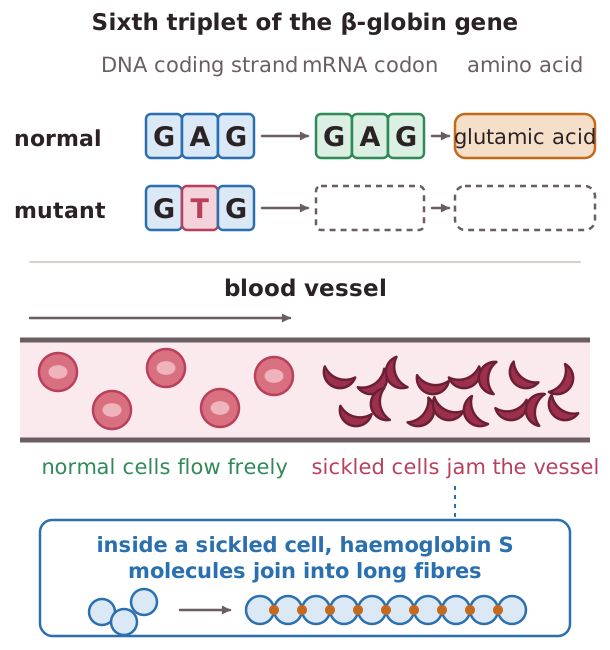 Effects of sickled cells:
• they carry less oxygen
• they can block capillaries, causing severe pain and damage to tissues and organs
• they are destroyed quickly, causing anaemia and tirednessThe allele is recessive. People with two HbS alleles have sickle cell disease. Carriers (HbA HbS) have sickle cell trait: they usually have no symptoms and are more resistant to malaria.Worked example: two carriers (HbA HbS) have a child. The possible genotypes are HbA HbA, HbA HbS, HbS HbA and HbS HbS, so the chance of the child having sickle cell disease is 1 in 4 (25%).
Effects of sickled cells:• they carry less oxygen
• they can block capillaries, causing severe pain and damage to tissues and organs
• they are destroyed quickly, causing anaemia and tirednessThe allele is recessive. People with two HbS alleles have sickle cell disease. Carriers (HbA HbS) have sickle cell trait: they usually have no symptoms and are more resistant to malaria.Worked example: two carriers (HbA HbS) have a child. The possible genotypes are HbA HbA, HbA HbS, HbS HbA and HbS HbS, so the chance of the child having sickle cell disease is 1 in 4 (25%).