A gene is a sequence of bases on a DNA molecule that codes for the sequence of amino acids in a polypeptide. Protein synthesis is the process of using that code to build the polypeptide. It happens in two stages.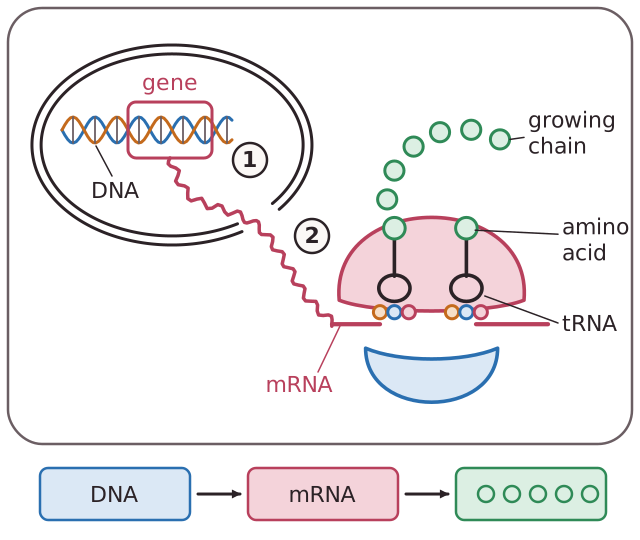 1. Transcription happens in the nucleus. The base sequence of a gene is copied into a molecule of mRNA.2. Translation happens at the ribosomes in the cytoplasm. The mRNA codons are read and tRNA molecules bring the matching amino acids, which are joined into a polypeptide.Why is an mRNA copy needed? DNA is too large to leave the nucleus through the nuclear pores, and keeping it in the nucleus protects it from damage. Many mRNA copies of one gene can be made, so the protein can be made quickly in large amounts.The information passes: DNA → mRNA → polypeptide. All three types of RNA are involved: mRNA carries the code, tRNA brings the amino acids, and rRNA (in ribosomes) holds everything in place and joins the amino acids.The polypeptide then folds into its secondary and tertiary structure and may combine with other polypeptides to form a functional protein.Worked example: a DNA template triplet is TAC. Transcription gives the mRNA codon AUG. In translation, a tRNA with anticodon UAC pairs with it and brings the amino acid methionine.