Chromosome mutations affect large sections of DNA or whole chromosomes, so they usually change many genes at once. They often happen when chromosomes break or are separated incorrectly during meiosis.Changes in chromosome structure:
• deletion: a section of chromosome breaks off and is lost
• duplication: a section is repeated, so genes are present in extra copies
• inversion: a section breaks off, turns round through 180° and rejoins, so the gene order in that section is reversed
• translocation: a section breaks off one chromosome and joins a different, non-homologous chromosomeChanges in chromosome number:
• aneuploidy: one chromosome too many or too few. It is caused by non-disjunction, when homologous chromosomes or sister chromatids fail to separate during meiosis, so a gamete has an extra or missing chromosome. For example, Down syndrome is caused by an extra copy of chromosome 21 (trisomy 21).
• polyploidy: whole extra sets of chromosomes, such as 3n or 4n. It is rare in animals but common in plants; bread wheat is hexaploid (6n).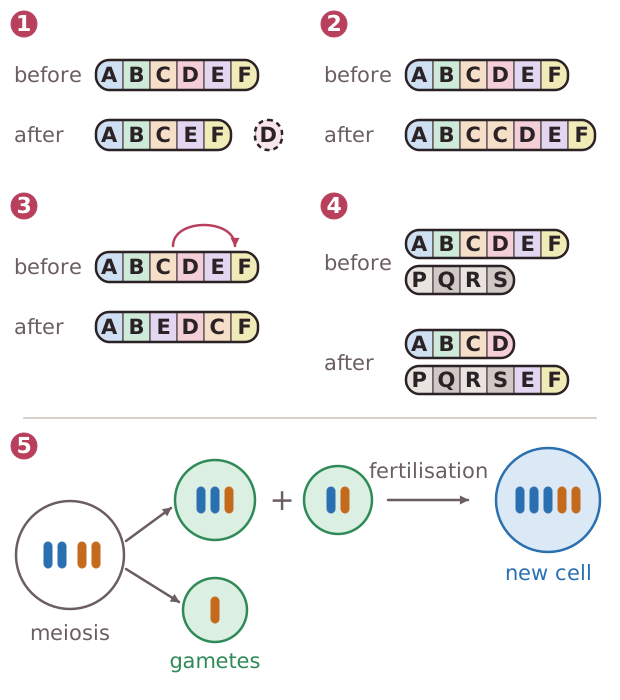 Worked example: human body cells normally contain 46 chromosomes (23 pairs). A person with trisomy 21 has one extra chromosome, so each body cell contains 47 chromosomes.
• deletion: a section of chromosome breaks off and is lost
• duplication: a section is repeated, so genes are present in extra copies
• inversion: a section breaks off, turns round through 180° and rejoins, so the gene order in that section is reversed
• translocation: a section breaks off one chromosome and joins a different, non-homologous chromosomeChanges in chromosome number:
• aneuploidy: one chromosome too many or too few. It is caused by non-disjunction, when homologous chromosomes or sister chromatids fail to separate during meiosis, so a gamete has an extra or missing chromosome. For example, Down syndrome is caused by an extra copy of chromosome 21 (trisomy 21).
• polyploidy: whole extra sets of chromosomes, such as 3n or 4n. It is rare in animals but common in plants; bread wheat is hexaploid (6n).
Worked example: human body cells normally contain 46 chromosomes (23 pairs). A person with trisomy 21 has one extra chromosome, so each body cell contains 47 chromosomes.