A gene mutation (point mutation) changes one or a few bases in the DNA of a gene. There are three main types.Substitution: one base is replaced by another. Only one codon changes, so the effect depends on the new codon:
• silent: the new codon codes for the same amino acid, because the genetic code is degenerate, so there is no change to the protein
• missense: a different amino acid is coded for, which may change the protein's shape and function
• nonsense: a stop codon is formed, so a shortened, usually non-functional, polypeptide is madeInsertion (addition): an extra base is added.
Deletion: a base is lost.Because the code is non-overlapping and read in triplets, inserting or deleting one base shifts the reading frame. Every codon after the mutation changes. This is a frameshift, and it usually changes many amino acids, producing a non-functional protein. If three bases (one whole codon) are inserted or deleted, there is no frameshift; one amino acid is added or lost.Worked example: the DNA reads CAT CAT CAT. Deleting the first A gives CTC ATC AT..., so every triplet after the deletion is different: a frameshift. Changing the second T to C gives CAT CAC CAT, where only one triplet changes: a substitution.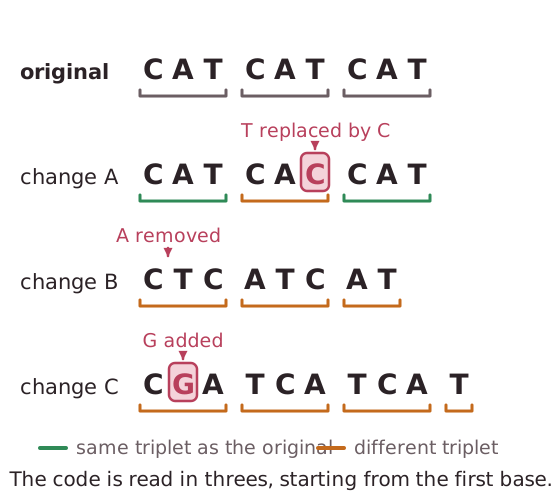
• silent: the new codon codes for the same amino acid, because the genetic code is degenerate, so there is no change to the protein
• missense: a different amino acid is coded for, which may change the protein's shape and function
• nonsense: a stop codon is formed, so a shortened, usually non-functional, polypeptide is madeInsertion (addition): an extra base is added.
Deletion: a base is lost.Because the code is non-overlapping and read in triplets, inserting or deleting one base shifts the reading frame. Every codon after the mutation changes. This is a frameshift, and it usually changes many amino acids, producing a non-functional protein. If three bases (one whole codon) are inserted or deleted, there is no frameshift; one amino acid is added or lost.Worked example: the DNA reads CAT CAT CAT. Deleting the first A gives CTC ATC AT..., so every triplet after the deletion is different: a frameshift. Changing the second T to C gives CAT CAC CAT, where only one triplet changes: a substitution.