Transcription is the first stage of protein synthesis: a gene's base sequence is copied into mRNA. It happens in the nucleus.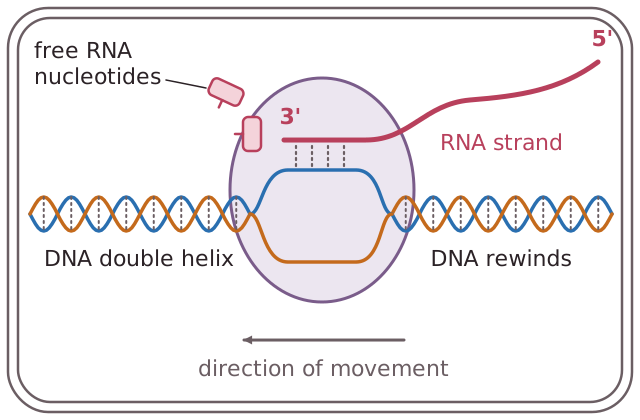 1. RNA polymerase binds to the DNA at the start of the gene.
2. The hydrogen bonds between the two DNA strands break and the DNA unwinds, exposing the bases of that gene only.
3. Only one strand, the template strand (antisense strand), is used.
4. Free RNA nucleotides pair with their complementary bases on the template strand: C with G, G with C, T with A, and A on the DNA with uracil on the RNA.
5. RNA polymerase joins the RNA nucleotides with phosphodiester bonds, forming a single strand of mRNA.
6. The DNA rewinds behind the RNA polymerase. When a stop sequence is reached, the RNA polymerase and the mRNA are released.The mRNA is complementary to the template strand, so it has the same base sequence as the other strand, the coding strand (sense strand), except that U replaces T.Unlike DNA replication, transcription copies only one gene, uses only one strand, and uses RNA nucleotides (with ribose and uracil). In eukaryotes the mRNA is then spliced and leaves the nucleus through a nuclear pore.Worked example: the template strand reads TAC CGA. The mRNA is AUG GCU. The coding strand reads ATG GCT, the same as the mRNA with T for U.
1. RNA polymerase binds to the DNA at the start of the gene.2. The hydrogen bonds between the two DNA strands break and the DNA unwinds, exposing the bases of that gene only.
3. Only one strand, the template strand (antisense strand), is used.
4. Free RNA nucleotides pair with their complementary bases on the template strand: C with G, G with C, T with A, and A on the DNA with uracil on the RNA.
5. RNA polymerase joins the RNA nucleotides with phosphodiester bonds, forming a single strand of mRNA.
6. The DNA rewinds behind the RNA polymerase. When a stop sequence is reached, the RNA polymerase and the mRNA are released.The mRNA is complementary to the template strand, so it has the same base sequence as the other strand, the coding strand (sense strand), except that U replaces T.Unlike DNA replication, transcription copies only one gene, uses only one strand, and uses RNA nucleotides (with ribose and uracil). In eukaryotes the mRNA is then spliced and leaves the nucleus through a nuclear pore.Worked example: the template strand reads TAC CGA. The mRNA is AUG GCU. The coding strand reads ATG GCT, the same as the mRNA with T for U.