Globular proteins are proteins whose polypeptide chains are folded into compact, roughly spherical shapes.During folding, hydrophobic R groups turn towards the centre of the molecule, away from water, while hydrophilic R groups end up on the outside. Because the outside of the molecule is hydrophilic, globular proteins are soluble in water. This means they can be transported in the blood and can move freely in the cytoplasm.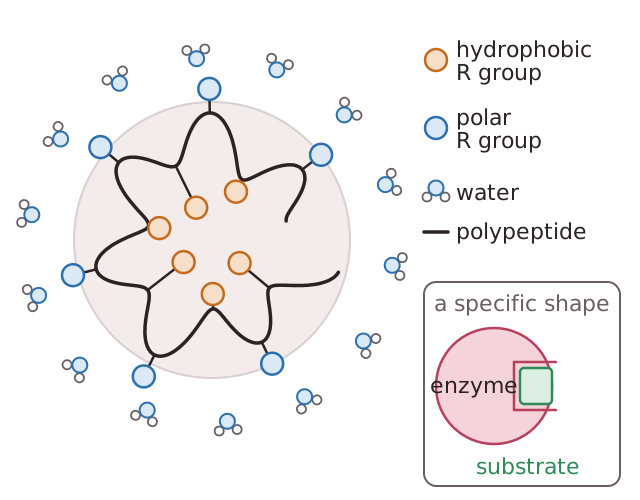 Each globular protein has a precise tertiary (and sometimes quaternary) structure, so it has a very specific shape. This makes them well suited to metabolic roles, where the protein must recognise or bind a particular molecule:• enzymes, such as amylase, whose active site fits one substrate
• transport proteins, such as haemoglobin, which carries oxygen in red blood cells, and carrier and channel proteins in membranes
• hormones, such as insulin, which binds to specific receptors
• antibodies, which bind to specific antigensBecause their function depends on their exact shape, globular proteins are easily affected by changes in temperature and pH. Breaking the hydrogen bonds and ionic bonds that hold the shape denatures the protein, and it stops working.Worked example: an enzyme is heated to 80 °C. The hydrogen bonds holding its tertiary structure break, the active site changes shape, and the substrate no longer fits, so the reaction stops even when the enzyme cools.Globular proteins contrast with fibrous proteins, which are long, insoluble and structural.
Each globular protein has a precise tertiary (and sometimes quaternary) structure, so it has a very specific shape. This makes them well suited to metabolic roles, where the protein must recognise or bind a particular molecule:• enzymes, such as amylase, whose active site fits one substrate• transport proteins, such as haemoglobin, which carries oxygen in red blood cells, and carrier and channel proteins in membranes
• hormones, such as insulin, which binds to specific receptors
• antibodies, which bind to specific antigensBecause their function depends on their exact shape, globular proteins are easily affected by changes in temperature and pH. Breaking the hydrogen bonds and ionic bonds that hold the shape denatures the protein, and it stops working.Worked example: an enzyme is heated to 80 °C. The hydrogen bonds holding its tertiary structure break, the active site changes shape, and the substrate no longer fits, so the reaction stops even when the enzyme cools.Globular proteins contrast with fibrous proteins, which are long, insoluble and structural.