Fibrous proteins are long, thin proteins made of polypeptide chains arranged in parallel to form fibres or sheets.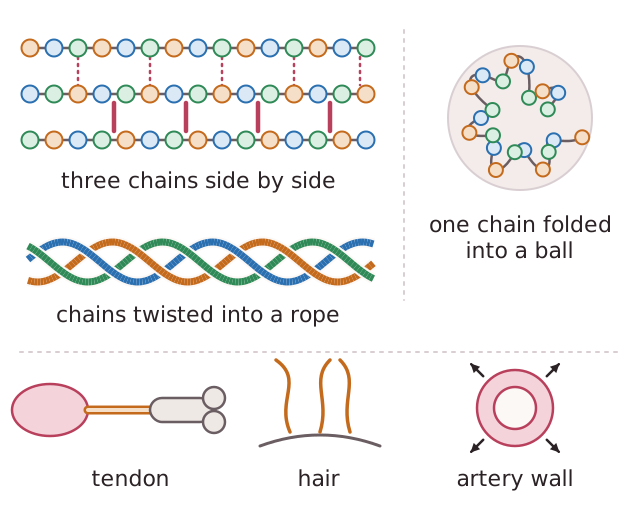 Their key features are:
• a repetitive primary structure: the same short sequence of amino acids repeats many times, so the chains form regular structures
• little or no tertiary folding: chains stay long rather than folding into a ball
• many cross-links between chains (hydrogen bonds, and covalent bonds such as disulfide bridges), which make them strong
• many hydrophobic R groups on the outside, so they are insoluble in waterThese properties make fibrous proteins ideal for structural roles, where strength and stability matter more than a precise binding shape.Examples:
• collagen: gives strength in tendons, ligaments, skin, bone and artery walls
• keratin: in hair, nails, horns, feathers and the outer layer of skin; rich in disulfide bridges, so it is tough
• elastin: in the walls of arteries, the skin and the lungs; it can stretch and recoilComparison with globular proteins:
• shape: long and fibrous (fibrous) versus compact and spherical (globular)
• solubility: insoluble versus soluble
• role: structural versus metabolic
• sequence: repetitive versus irregular
• stability: less easily denatured versus sensitive to heat and pHWorked example: a protein that is insoluble, has a repeating sequence of three amino acids and is found in tendons is fibrous; it is collagen.
Their key features are:• a repetitive primary structure: the same short sequence of amino acids repeats many times, so the chains form regular structures
• little or no tertiary folding: chains stay long rather than folding into a ball
• many cross-links between chains (hydrogen bonds, and covalent bonds such as disulfide bridges), which make them strong
• many hydrophobic R groups on the outside, so they are insoluble in waterThese properties make fibrous proteins ideal for structural roles, where strength and stability matter more than a precise binding shape.Examples:
• collagen: gives strength in tendons, ligaments, skin, bone and artery walls
• keratin: in hair, nails, horns, feathers and the outer layer of skin; rich in disulfide bridges, so it is tough
• elastin: in the walls of arteries, the skin and the lungs; it can stretch and recoilComparison with globular proteins:
• shape: long and fibrous (fibrous) versus compact and spherical (globular)
• solubility: insoluble versus soluble
• role: structural versus metabolic
• sequence: repetitive versus irregular
• stability: less easily denatured versus sensitive to heat and pHWorked example: a protein that is insoluble, has a repeating sequence of three amino acids and is found in tendons is fibrous; it is collagen.