Collagen is the most abundant protein in mammals. It is a fibrous protein that gives tensile strength to tendons, ligaments, skin, cartilage, bone and the walls of arteries.Structure of one molecule. A collagen molecule is made of three polypeptide chains, each about 1000 amino acids long. Each chain is a tight helix, and the three chains are wound around each other to form a triple helix, like a rope.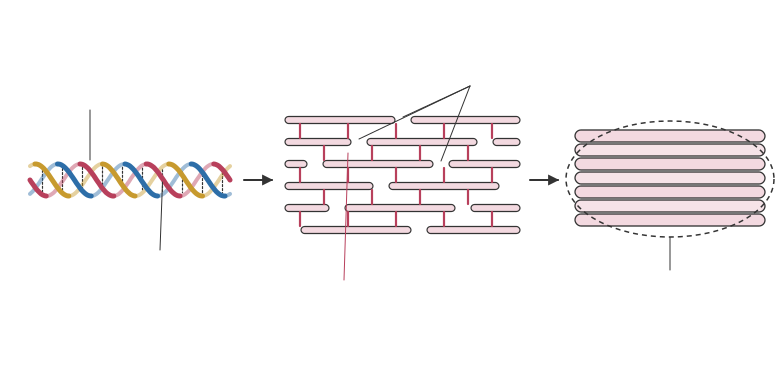
• triple helix, hydrogen bonds and covalent cross-links give very high tensile strength
• staggered ends avoid weak points along the fibre
• it is insoluble and stable, so it lasts in the body
• it is flexible but does not stretch much, ideal for tendons, which transmit the pull of muscle to boneWorked example: a collagen chain of 1050 amino acids has glycine every third position, so it contains 1050 ÷ 3 = 350 glycines.