 BRAINCAKE
DNA Semi-Conservative Replication
Organisms grow and reproduce by cell division. Before the cell divides, the DNA must be replicated to ensure the amount of DNA in each cell stays the same and each cell has the correct number of chromosomes and the complete genome.
DNA replication is semi-conservative. This means that each new copy of DNA is made up of an old strand and a new strand is synthesised on the old strand using the old strand as a template.
The new strand is complementary to the old strand.
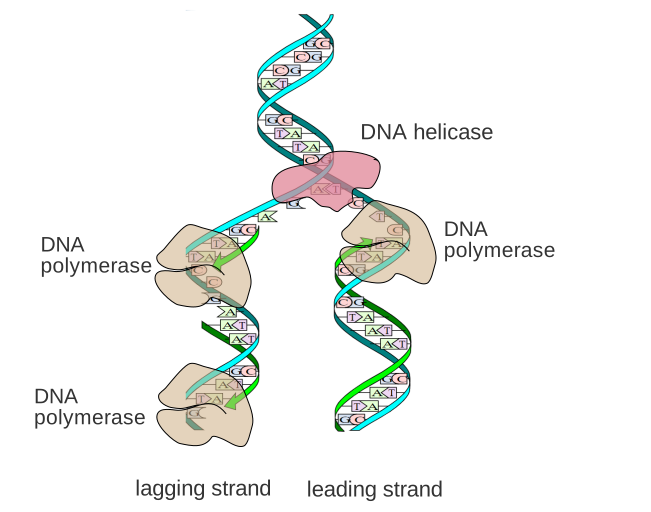
Sign in free to see the rest of this lesson, the R.E.C.I.P.E. recall steps and the quiz
BrainCake is free. Make an account in seconds and pick up where this page stops.
Key terms in this lesson
- hydrogen bond
- A weak electrostatic attraction between a slightly positive hydrogen atom on one polar molecule and a slightly negative atom, such as oxygen or nitrogen, on another.
- condensation reaction
- A reaction that joins two molecules together with a covalent bond, with the elimination of a water molecule.
- hydrolysis
- The breaking of a covalent bond within a molecule using a water molecule.
- nucleotide
- A molecule made of a pentose sugar, a phosphate group and a nitrogen-containing base.
- genome
- The complete set of genes possessed by an organism.
More in Nucleic Acids
- Complementary Base Pairing
- Stability of the Double Helix
- Function of DNA
- Discovering DNA as the Hereditary Material
- Evidence for Semi-Conservative Replication
- ATP
- ATP Synthesis
- Roles of ATP
All 18 lessons in Nucleic Acids · All AQA AS-level Biology topics