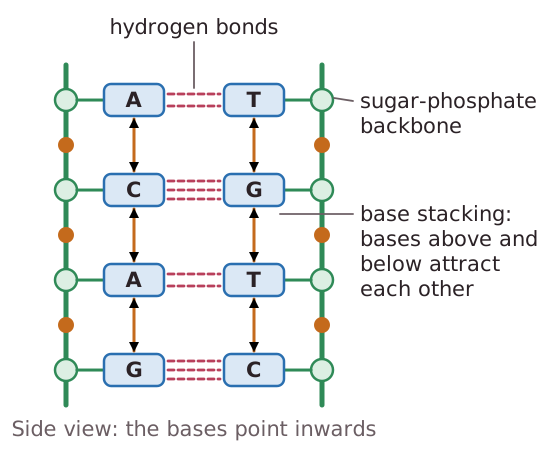
The phosphate and sugar groups are joined together by phosphodiester bonds to form the sugar-phosphate backbone of each strand of the DNA molecule.The two strands wind round each other with the bases pointing inwards so the phosphodiester backbone protects the bases from chemical damage.Hydrogen bonds link the complementary base pairs together. The greater the proportion of C≡G pairs, the more stable the DNA molecule.Other significant forces are hydrophobic interactions and intermolecular forces between bases stacked on top of one another. This Base stacking is an important contributor to the stability of DNA.