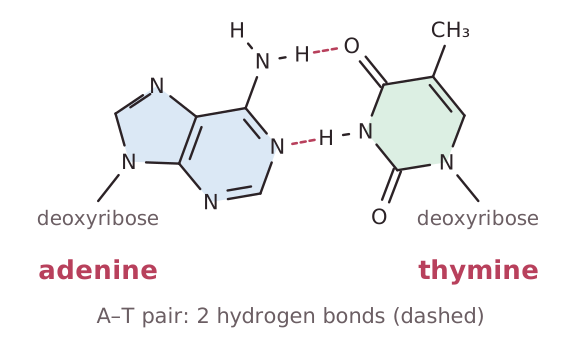
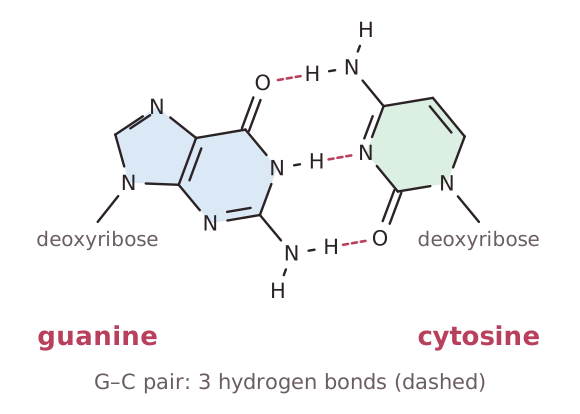
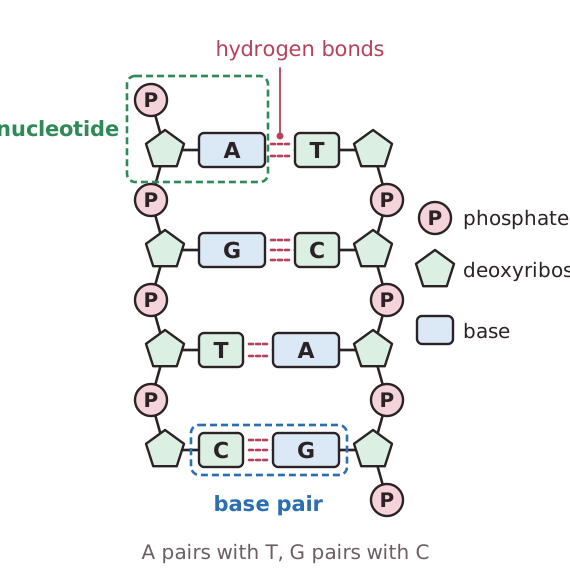
The bases on each strand form hydrogen bonds that hold the two strands together.Adenine pairs with thymine and forms two hydrogen bonds. Adenine is complementary to thymine.Guanine pairs with cytosine and forms three hydrogen bonds. Guanine and cytosine are complementary base pairs.
Complementary Base Pairing
Read the text
Read the text and highlight anything you think is important. When you go on, the text is hidden and you answer from memory.
Specification: AQA Biology (7401), AS-level, 3.1.5.2 DNA replication and 3.1.5.1 Structure of DNA and RNA. Topic: Nucleic Acids.
Key terms in this lesson
- hydrogen bond
- A weak electrostatic attraction between a slightly positive hydrogen atom on one polar molecule and a slightly negative atom, such as oxygen or nitrogen, on another.
More in Nucleic Acids
- Nucleotides
- RNA
- DNA
- Stability of the Double Helix
- Function of DNA
- Discovering DNA as the Hereditary Material
- DNA Semi-Conservative Replication
- Evidence for Semi-Conservative Replication
All 18 lessons in Nucleic Acids · All AQA AS-level Biology topics