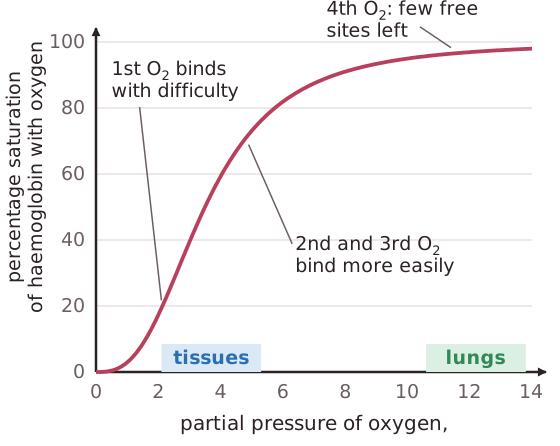
The oxygen dissociation curve shows the relationship between the partial pressure of oxygen in the environment and the percentage saturation of haemoglobin with oxygen.At low oxygen concentrations, little oxygen is bound to haemoglobin because the subunits are closely bound and in close proximity making it difficult for the first oxygen molecule to bind.The binding of the second molecules is easier due to the change in the shape of the haemoglobin molecule when the first oxygen molecule binds. It takes a smaller increase in partial pressure to bind the second molecule so the gradient of the curve is steeper.Binding of the third molecule is made easier by the binding of the second molecule. The subsequent ease of binding of one molecule due to the binding of another molecule by the change in shape is called positive cooperativity.With most of the binding site occupied the probability of the fourth molecule finding an empty binding site is low so the graph flattens.The further to the left the curve, the greater the affinity of haemoglobin for oxygen.