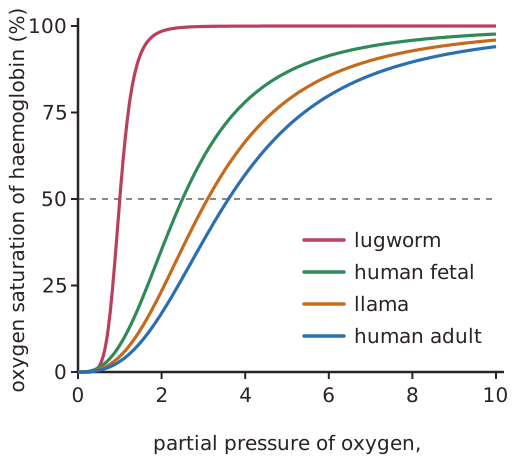
Llamas are able to live at high altitude where atmospheric pressure is lower and the partial pressure of oxygen in the air is lower.They have efficient mechanisms of oxygen extraction from the air.Llama haemoglobin differs from the human haemoglobin in that it has 25 different amino acids in the alpha chain and 24 different amino acids in the beta chain.Llama haemoglobin has a high affinity for oxygen both at sea level and at altitude. The oxygen dissociation curve is shifted to the left of the oxygen dissociation curve for humans.
Read the text
Read the text and highlight anything you think is important. When you go on, the text is hidden and you answer from memory.
Specification: AQA Biology (7401), AS-level, 3.3.4.1 Mass transport in animals. Topic: Mass Transport in Animals.
Key terms in this lesson
- haemoglobin
- A globular, quaternary protein in red blood cells, made of four polypeptide chains each with a haem group, that binds and transports oxygen.
- oxygen dissociation curve
- A graph showing the relationship between the partial pressure of oxygen and the percentage saturation of haemoglobin with oxygen.
More in Mass Transport in Animals
- Oxygen Dissociation Curve
- Effect of Carbon Dioxide
- Transport of Oxygen
- Lugworm
- Fetal Haemoglobin
- Myoglobin
- The Need for a Transport System
- Features of a Transport System
All 27 lessons in Mass Transport in Animals · All AQA AS-level Biology topics