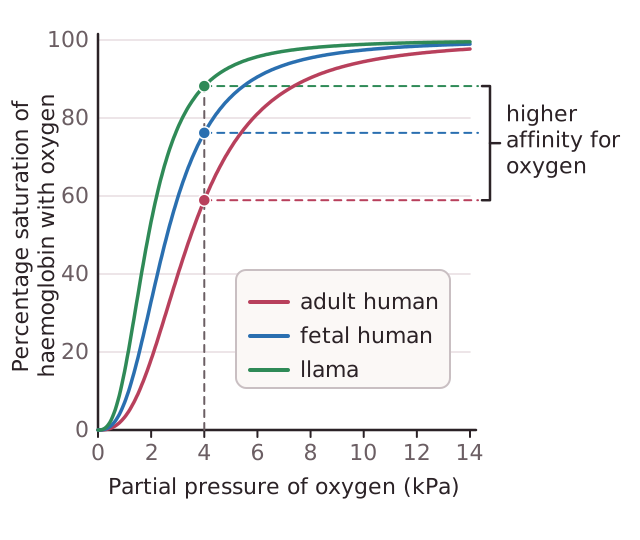
Many organisms have haemoglobin.There are different types of haemoglobin in different organisms.The different types of haemoglobin have different properties due to slightly different primary structures (sequence of amino acids).The different primary structures lead to different tertiary and quaternary structures which results in different binding affinities for oxygen.The different haemoglobins are adaptations to different environments and conditions.In humans, fetal haemoglobin has a higher affinity for oxygen than adult haemoglobin.Llama haemoglobin has a higher affinity for oxygen than human haemoglobin. Llamas live at high altitude where the partial pressure of oxygen is low.
Different Types of Haemoglobin
Read the text
Read the text and highlight anything you think is important. When you go on, the text is hidden and you answer from memory.
Specification: AQA Biology (7401), AS-level, 3.3.4.1 Mass transport in animals. Topic: Mass Transport in Animals.
Key terms in this lesson
- haemoglobin
- A globular, quaternary protein in red blood cells, made of four polypeptide chains each with a haem group, that binds and transports oxygen.
More in Mass Transport in Animals
- Haemoglobin
- Loading and Unloading Oxygen
- Oxygen Dissociation Curve
- Effect of Carbon Dioxide
- Transport of Oxygen
- Lugworm
- Llama
- Fetal Haemoglobin
All 27 lessons in Mass Transport in Animals · All AQA AS-level Biology topics