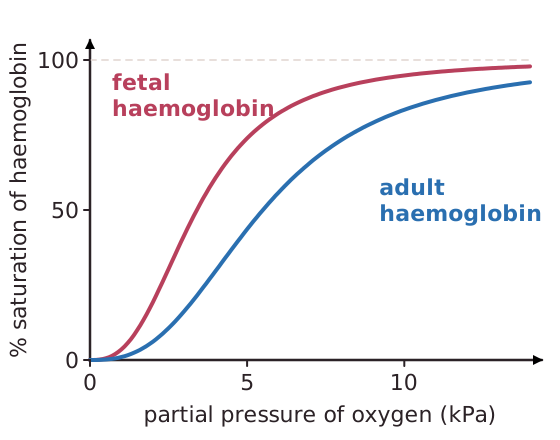
Human fetal haemoglobin (Haemoglobin F) is the major haemoglobin in fetal red blood cells. In new-borns 60 to 80 percent of their total haemoglobin is fetal haemoglobin.By about 6 to 12 months of age, fetal haemoglobin is almost totally replaced by adult haemoglobinThe role of fetal haemoglobin is to transfer oxygen from maternal blood to fetal tissues.Fetal haemoglobin has a higher affinity for oxygen than adult haemoglobin.Haemoglobin F has a different composition than adult haemoglobin.Fetal haemoglobin is made from two alpha-globin and two gamma-globin chains.Its greater affinity for oxygen allows it to associate with oxygen more strongly than adult haemoglobin. This enables the developing fetus to retrieve oxygen from the mother's bloodstream, which occurs through the placenta found in the mother's uterus.