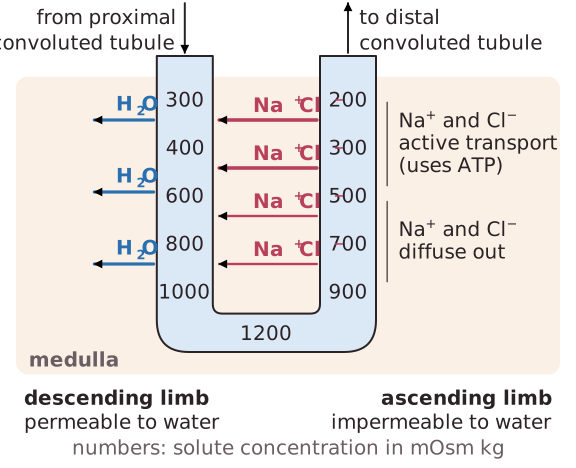
Fluid passes from the top of the ascending limb of loop of Henlé to a short distal convoluted tubule. Active transport is used to adjust the concentration of various salts. The collecting duct carries the fluid through the medulla to the pelvis. The tissue fluid in the medulla has a low water potential so water moves out of the collecting ducts by osmosis.About 1.5 to 2.0 dm3 of urine reach the pelvis each day. The walls of the collecting duct have membrane-bound receptors for ADH. ADH binds to receptors causing enzyme controlled reactions which insert water-permeable channels or aquaporins into the cell membranes allowing more water to be reabsorbed. When there is less ADH the channels are removed by infolding of the membrane.
Distal Tubule and Collecting Duct
Read the text
Read the text and highlight anything you think is important. When you go on, the text is hidden and you answer from memory.
Specification: OCR Biology A (H420), A-level, 5.1.2 Excretion as an example of homeostatic control. Topic: Homeostasis.
Key terms in this lesson
- Neurone
- A specialised nerve cell adapted to transmit electrical impulses (nerve impulses) around the body.
- Neurotransmitter
- A chemical released from the presynaptic membrane at a synapse that diffuses across the synaptic cleft and binds to receptors on the postsynaptic membrane, triggering a response.
- Effector
- A muscle or gland that brings about a response to a stimulus.
- Autonomic nervous system
- The part of the peripheral nervous system that controls involuntary functions such as those of cardiac muscle, smooth muscle and glands.
- Sympathetic nervous system
- The division of the autonomic nervous system responsible for the fight-or-flight response, generally increasing activity.
More in Homeostasis
- Proximal Convoluted Tubule
- Loop of Henlé
- Countercurrent Multiplier
- Ultrafiltration, Selective Reabsorption and Osmoregulation.
- ADH
- Kidney failure
- Haemodialysis
- Peritoneal Dialysis
All 33 lessons in Homeostasis · All OCR A-level Biology topics