 BRAINCAKE
Ultrafiltration, Selective Reabsorption and Osmoregulation.
Blood is filtered under pressure in the Bowman's capsule. The filtrate is the same composition as blood plasma except for an absence of large proteins and a lower protein concentration. Substances in the filtrate include amino-acids, urea, glucose, water and inorganic ions such as sodium, chloride and potassium ions. Glucose, amino-acids and inorganic ions are selectively reabsorbed in the proximal convoluted tubule.
Sign in free to see the rest of this lesson, the R.E.C.I.P.E. recall steps and the quiz
BrainCake is free. Make an account in seconds and pick up where this page stops.
Key terms in this lesson
- Hormone
- A chemical messenger, secreted directly into the blood by an endocrine gland, that travels to target cells and alters their activity.
- Osmoregulation
- The control of the water potential of the blood and body fluids.
- Ultrafiltration
- The filtration of blood under high hydrostatic pressure through the basement membrane of the Bowman's capsule, producing a filtrate free of large proteins and cells.
- Selective reabsorption
- The process by which useful substances such as glucose, amino acids, ions and water are reabsorbed from the filtrate back into the blood, mainly in the proximal convoluted tubule.
- Loop of Henle
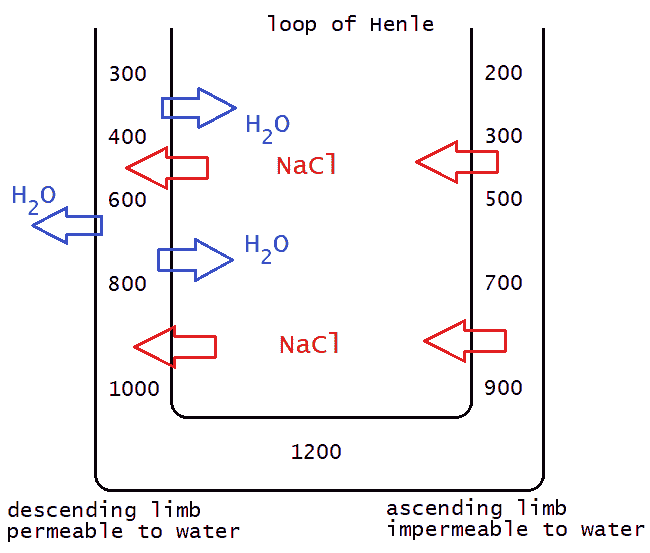
- The part of the nephron that dips into the medulla and, through a countercurrent multiplier mechanism, creates a low water potential that allows water to be reabsorbed from the filtrate.
More in Homeostasis
- Glomerulus
- Proximal Convoluted Tubule
- Loop of Henlé
- Countercurrent Multiplier
- Distal Tubule and Collecting Duct
- ADH
- Kidney failure
- Haemodialysis
All 33 lessons in Homeostasis · All OCR A-level Biology topics