A point quadrat (point frame) is a frame holding a row of long pins, usually 10, which are lowered one at a time to the ground. Every plant species that a pin touches on the way down is recorded as a hit.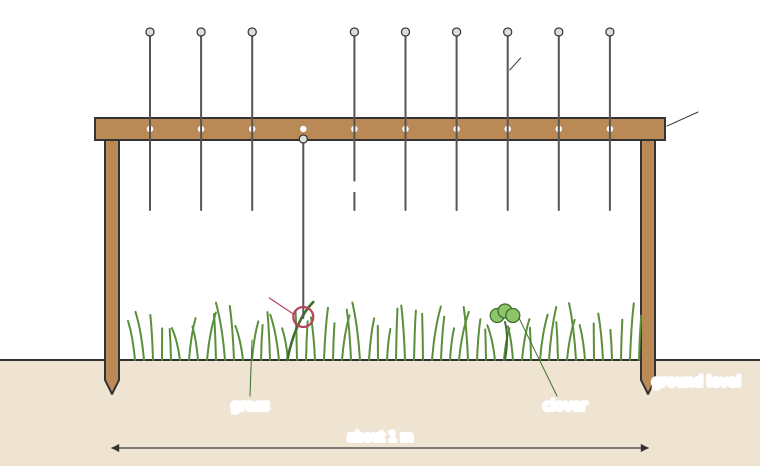
1. Place the frame at a random position.
2. Lower each pin in turn and record every species it touches.
3. Repeat at many random positions.
4. Calculate the percentage cover of each species.percentage cover = (hits for the species ÷ total number of pins lowered) × 100 Worked example: the frame is placed 5 times, so 5 × 10 = 50 pins are lowered. Grass is touched by 35 pins.cover of grass = 35 ÷ 50 × 100 = 70% One pin may touch several plants layered above each other, so the total cover of all species can be more than 100%.Advantages:
- More objective and accurate than estimating cover by eye, because a pin either touches a plant or it does not.
- Works well for dense, low vegetation such as grassland, where individual plants cannot be counted.Disadvantages:
- Slow, and unsuitable for tall vegetation or shrubs.
- Small or rare species may be missed because the pins sample only single points.
- Plants moving in the wind make hits uncertain.Pins should be lowered vertically and slowly, so that they do not push leaves aside.
1. Place the frame at a random position.
2. Lower each pin in turn and record every species it touches.
3. Repeat at many random positions.
4. Calculate the percentage cover of each species.
- More objective and accurate than estimating cover by eye, because a pin either touches a plant or it does not.
- Works well for dense, low vegetation such as grassland, where individual plants cannot be counted.Disadvantages:
- Slow, and unsuitable for tall vegetation or shrubs.
- Small or rare species may be missed because the pins sample only single points.
- Plants moving in the wind make hits uncertain.Pins should be lowered vertically and slowly, so that they do not push leaves aside.