Ecologists cannot count every organism in a habitat, so they take samples and use them to estimate the whole population. A good sample must be representative of the habitat.The choice of method depends on the question:
- Random sampling is used to estimate abundance or compare two areas. Lay out two tape measures at right angles to form a grid, then use a random number generator to pick coordinates. This removes bias in choosing where to sample.
- Systematic sampling is used where conditions change across an area, for example from a hedge into a field. Samples are taken at regular intervals along a line.Common tools:
- Quadrats: square frames for sampling plants and slow-moving animals.
- Transects: lines along which samples are taken.
- Traps and nets for mobile animals.
- Identification keys to name the organisms found.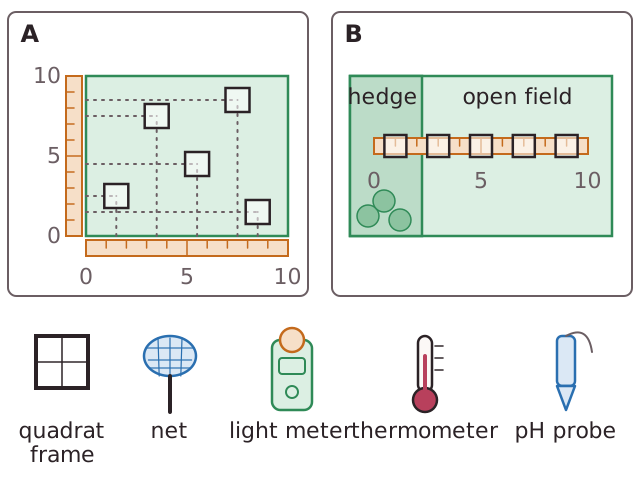 Abiotic factors should be measured at each sampling point: a light meter for light intensity, a thermometer or temperature probe, a soil moisture meter, and a pH probe or indicator for soil pH. Data loggers can record these continuously.To make results reliable, take enough samples. Plotting a running mean shows when adding more samples no longer changes the mean much, so you know you have enough. Repeating the whole survey also tests repeatability.Fieldwork must be safe and ethical: return organisms to where they were found and disturb the habitat as little as possible.
- Random sampling is used to estimate abundance or compare two areas. Lay out two tape measures at right angles to form a grid, then use a random number generator to pick coordinates. This removes bias in choosing where to sample.
- Systematic sampling is used where conditions change across an area, for example from a hedge into a field. Samples are taken at regular intervals along a line.Common tools:
- Quadrats: square frames for sampling plants and slow-moving animals.
- Transects: lines along which samples are taken.
- Traps and nets for mobile animals.
- Identification keys to name the organisms found.
Abiotic factors should be measured at each sampling point: a light meter for light intensity, a thermometer or temperature probe, a soil moisture meter, and a pH probe or indicator for soil pH. Data loggers can record these continuously.To make results reliable, take enough samples. Plotting a running mean shows when adding more samples no longer changes the mean much, so you know you have enough. Repeating the whole survey also tests repeatability.Fieldwork must be safe and ethical: return organisms to where they were found and disturb the habitat as little as possible.