A quadrat is a square frame, often 0.5 m × 0.5 m (0.25 m2) or 1 m × 1 m, placed on the ground to mark out a standard area for sampling. Some are divided by strings into a grid of 100 small squares to help estimate cover. Quadrats are used for plants and for animals that move slowly or not at all, such as limpets.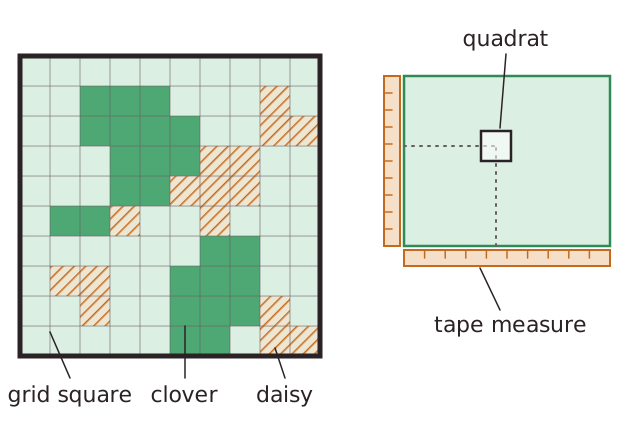 Method for random sampling:
1. Mark out the study area with two tape measures at right angles.
2. Generate random coordinates and place the quadrat there.
3. Record the species present and measure their abundance.
4. Repeat for many quadrats and calculate the mean.Ways to record abundance in a quadrat:
- Density: count the individuals of each species.
- Percentage cover: estimate the percentage of the quadrat covered by each species. Used when individual plants are hard to count. With a gridded quadrat, count the small squares more than half filled.
- Frequency: record simply whether the species is present.
- A subjective abundance scale such as ACFOR.The best quadrat size depends on the organism: small for mosses, larger for shrubs. It should be big enough to include the species but small enough to record accurately.Worked example: in a 100-square gridded quadrat, clover fills 38 squares, so it has 38% cover. Because plants overlap in layers, the total cover of all species in a quadrat can be more than 100%.Limitations: estimating cover by eye is subjective, and trampling while placing quadrats can disturb the area.
Method for random sampling:1. Mark out the study area with two tape measures at right angles.
2. Generate random coordinates and place the quadrat there.
3. Record the species present and measure their abundance.
4. Repeat for many quadrats and calculate the mean.Ways to record abundance in a quadrat:
- Density: count the individuals of each species.
- Percentage cover: estimate the percentage of the quadrat covered by each species. Used when individual plants are hard to count. With a gridded quadrat, count the small squares more than half filled.
- Frequency: record simply whether the species is present.
- A subjective abundance scale such as ACFOR.The best quadrat size depends on the organism: small for mosses, larger for shrubs. It should be big enough to include the species but small enough to record accurately.Worked example: in a 100-square gridded quadrat, clover fills 38 squares, so it has 38% cover. Because plants overlap in layers, the total cover of all species in a quadrat can be more than 100%.Limitations: estimating cover by eye is subjective, and trampling while placing quadrats can disturb the area.