Quadrats work for plants and slow-moving animals, but mobile animals need other methods.Collecting invertebrates
- Pitfall trap: a container sunk into the ground to catch ground-dwelling animals such as beetles. Cover it to keep out rain and check it often.
- Sweep net: swept through long grass to catch insects.
- Pooter: a tube used to suck small insects into a container.
- Kick sampling: disturbing a stream bed so that animals wash into a net held downstream.
- Tullgren funnel: a lamp warms and dries a soil sample, so small animals move down into a collecting pot.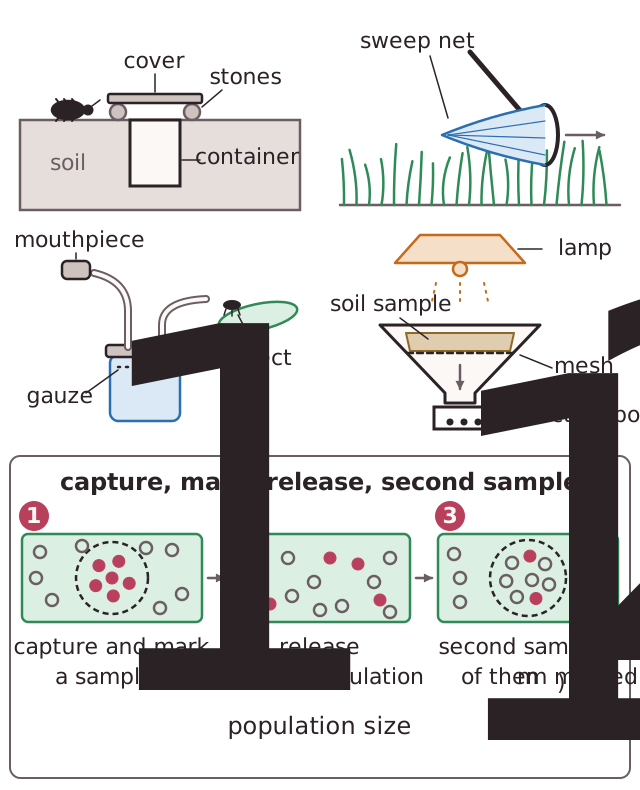 Mark-release-recapture
This estimates the population size of a mobile species:
1. Capture a sample, count them (n1) and mark each one harmlessly.
2. Release them and allow time for them to mix back into the population.
3. Capture a second sample (n2) and count how many are marked (m).population size N = (n1 × n2) ÷ m Worked example: 40 woodlice are caught and marked. Later 50 are caught, of which 10 are marked.N = (40 × 50) ÷ 10 = 200 woodlice The method assumes that:
- marks are not lost and do not affect survival, for example by making animals easier for predators to see
- marked animals mix fully with the rest of the population
- there is no significant birth, death, immigration or emigration between the two samples.If these assumptions are broken, the estimate is inaccurate. For example, if marked animals are eaten more often, fewer are recaptured, m is too small and the population is overestimated.
- Pitfall trap: a container sunk into the ground to catch ground-dwelling animals such as beetles. Cover it to keep out rain and check it often.
- Sweep net: swept through long grass to catch insects.
- Pooter: a tube used to suck small insects into a container.
- Kick sampling: disturbing a stream bed so that animals wash into a net held downstream.
- Tullgren funnel: a lamp warms and dries a soil sample, so small animals move down into a collecting pot.
Mark-release-recaptureThis estimates the population size of a mobile species:
1. Capture a sample, count them (n1) and mark each one harmlessly.
2. Release them and allow time for them to mix back into the population.
3. Capture a second sample (n2) and count how many are marked (m).
- marks are not lost and do not affect survival, for example by making animals easier for predators to see
- marked animals mix fully with the rest of the population
- there is no significant birth, death, immigration or emigration between the two samples.If these assumptions are broken, the estimate is inaccurate. For example, if marked animals are eaten more often, fewer are recaptured, m is too small and the population is overestimated.