In humans, sex is determined by the sex chromosomes. Females are XX and males are XY. The X chromosome is large and carries many genes; the Y chromosome is much smaller and carries very few, mostly for male development.A sex-linked gene is one carried on a sex chromosome, almost always the X chromosome. There is no matching locus on the Y chromosome for most of these genes.This means:• Females have two copies of each X-linked gene, so they can be homozygous or heterozygous. A heterozygous female with a recessive allele is a carrier.
• Males have only one copy. Whatever allele is on their single X is expressed, even if it is recessive.As a result, X-linked recessive characteristics are much more common in males than in females.Sex-linked alleles are written as superscripts on the X, for example XH and Xh. The Y is written with no allele.Worked example: a carrier female XHXh and a normal male XHY. Offspring: XHXH, XHXh, XHY, XhY. Each son has a ½ chance of being affected, and each daughter a ½ chance of being a carrier; no daughters are affected.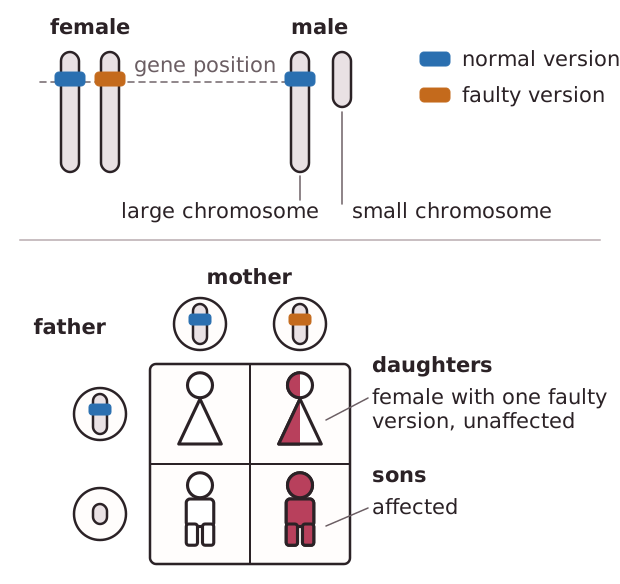 A father passes his X to all his daughters and his Y to all his sons. So a man cannot pass an X-linked allele to his sons, but all his daughters inherit it.
• Males have only one copy. Whatever allele is on their single X is expressed, even if it is recessive.As a result, X-linked recessive characteristics are much more common in males than in females.Sex-linked alleles are written as superscripts on the X, for example XH and Xh. The Y is written with no allele.Worked example: a carrier female XHXh and a normal male XHY. Offspring: XHXH, XHXh, XHY, XhY. Each son has a ½ chance of being affected, and each daughter a ½ chance of being a carrier; no daughters are affected.
A father passes his X to all his daughters and his Y to all his sons. So a man cannot pass an X-linked allele to his sons, but all his daughters inherit it.