Each chromosome carries hundreds or thousands of genes. Genes found on the same chromosome are said to be linked (autosomal linkage when the chromosome is not a sex chromosome).Linked genes do not assort independently. Because they are on the same chromosome, the alleles on that chromosome tend to be passed into the same gamete and inherited together. So Mendel's law of independent assortment does not apply to them.Worked example: genes A and B are linked. A fly has A and B on one chromosome and a and b on its homologue (written AB/ab). Without crossing over it makes only two gamete types, AB and ab, instead of the four (AB, Ab, aB, ab) expected for unlinked genes.Linked alleles can be separated by crossing over at chiasmata in prophase I. This produces recombinant chromatids with new combinations, here Ab and aB. Gametes with the original combinations are called parental (non-recombinant) types.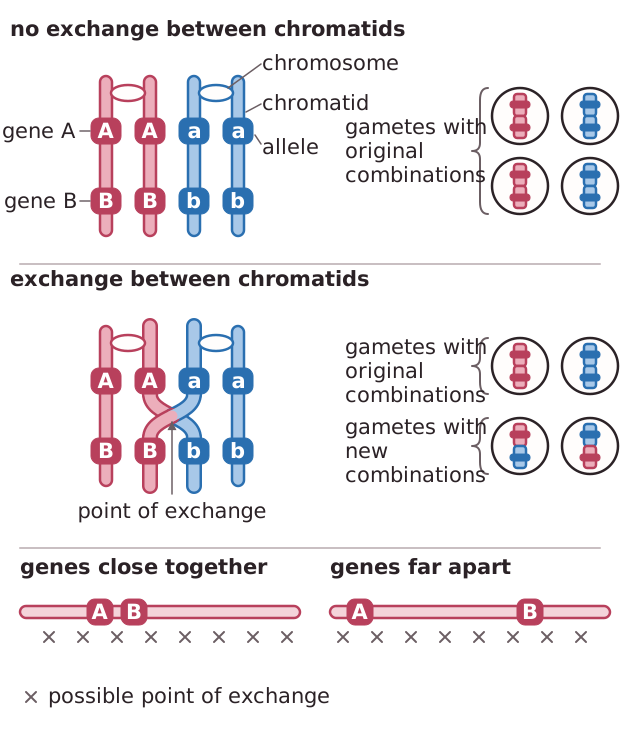 The chance of crossing over between two genes depends on the distance between them. Genes far apart on a chromosome are separated often; genes very close together are rarely separated and are almost always inherited together.So linked genes produce mostly parental-type offspring and fewer recombinant offspring than expected. In a dihybrid cross this changes the expected ratios: instead of 9 : 3 : 3 : 1 or 1 : 1 : 1 : 1, the parental phenotypes are over-represented.Linkage explains why some characteristics tend to appear together in families.