Mitochondria are the organelles where the link reaction, the Krebs cycle and oxidative phosphorylation take place. They are usually rod-shaped, about 1 µm wide and up to 10 µm long.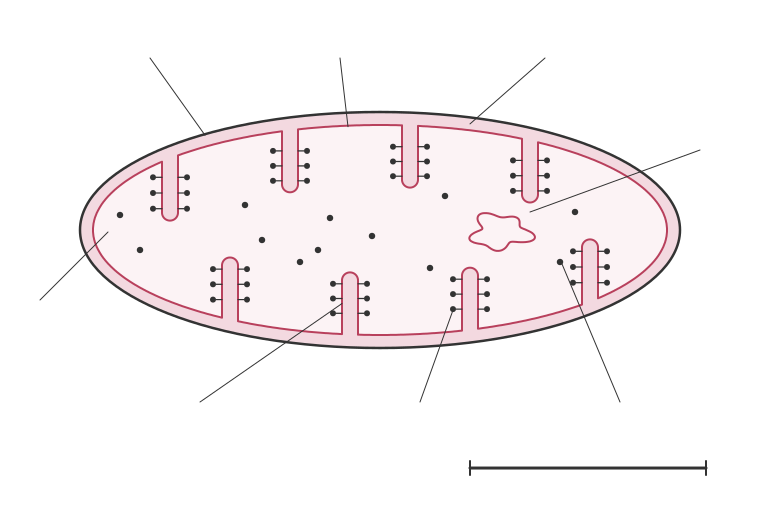
• Double membrane (envelope): separates the mitochondrion from the cytoplasm; pyruvate is actively transported across it into the matrix.
• Inner membrane, folded into cristae: the folds give a large surface area for the electron carriers of the electron transport chain and for the enzyme ATP synthase.
• Intermembrane space: the narrow gap between the two membranes, into which protons are pumped to form a gradient.
• Matrix: the fluid inside the inner membrane. It contains the enzymes of the link reaction and Krebs cycle, the coenzymes NAD and FAD, and oxaloacetate.
• Circular DNA and 70S ribosomes in the matrix, so mitochondria can make some of their own proteins.The inner membrane is impermeable to protons except where ATP synthase lets them through, which is essential for ATP production.Cells with a high demand for ATP, such as muscle cells, liver cells and the midpiece of sperm, contain many mitochondria with densely packed cristae. Cells that need little ATP have fewer mitochondria with fewer cristae.The circular DNA and 70S ribosomes, like those of bacteria, are evidence that mitochondria evolved from free-living prokaryotes (the endosymbiotic theory).