Aerobic respiration is respiration that uses oxygen. It releases far more energy from each glucose molecule than anaerobic respiration, because the glucose is broken down completely to carbon dioxide and water.The overall equation is:C6H12O6 + 6O2 → 6CO2 + 6H2O + energy Much of the energy released is used to make ATP; the rest is lost as heat.This equation hides many enzyme-controlled steps, grouped into four stages:
• glycolysis, in the cytoplasm: glucose is split into two molecules of pyruvate;
• the link reaction, in the mitochondrial matrix: pyruvate is converted to acetyl coenzyme A;
• the Krebs cycle, in the matrix: acetyl coenzyme A is oxidised, releasing carbon dioxide;
• oxidative phosphorylation, on the inner mitochondrial membrane (folded into cristae): hydrogen carried by reduced coenzymes drives the electron transport chain and most of the ATP is made.Oxygen is only used in the last stage, where it is the final acceptor of electrons and hydrogen, forming water. Without it, the last three stages stop and only glycolysis can continue.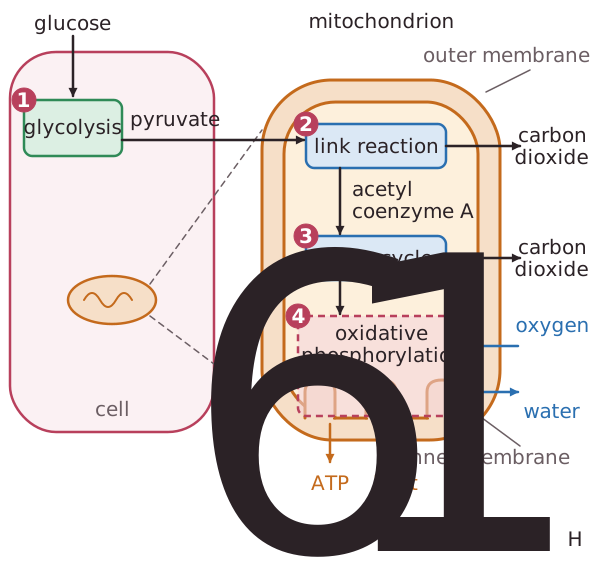 Worked example: respiring 3 glucose molecules aerobically needs 3 × 6 = 18 oxygen molecules and releases 18 carbon dioxide molecules.
• glycolysis, in the cytoplasm: glucose is split into two molecules of pyruvate;
• the link reaction, in the mitochondrial matrix: pyruvate is converted to acetyl coenzyme A;
• the Krebs cycle, in the matrix: acetyl coenzyme A is oxidised, releasing carbon dioxide;
• oxidative phosphorylation, on the inner mitochondrial membrane (folded into cristae): hydrogen carried by reduced coenzymes drives the electron transport chain and most of the ATP is made.Oxygen is only used in the last stage, where it is the final acceptor of electrons and hydrogen, forming water. Without it, the last three stages stop and only glycolysis can continue.
Worked example: respiring 3 glucose molecules aerobically needs 3 × 6 = 18 oxygen molecules and releases 18 carbon dioxide molecules.