How do we know which parts of the cell carry out each stage of respiration? The evidence comes from separating cell parts by cell fractionation and testing each fraction.Tissue such as liver is homogenised in a solution that is ice-cold (to slow enzymes that would damage organelles), isotonic (so organelles do not burst or shrink by osmosis) and buffered (to keep the pH constant). The homogenate is filtered and spun at increasing speeds, called differential centrifugation. Nuclei form a pellet first, mitochondria at a higher speed, and the final supernatant contains the cytoplasm.Typical results:
• Cytoplasm + glucose: pyruvate and a little ATP are made, with or without oxygen.
• Mitochondria + glucose: no oxygen is used and no ATP is made.
• Mitochondria + pyruvate + oxygen: oxygen is taken up, carbon dioxide is released and a large amount of ATP is made.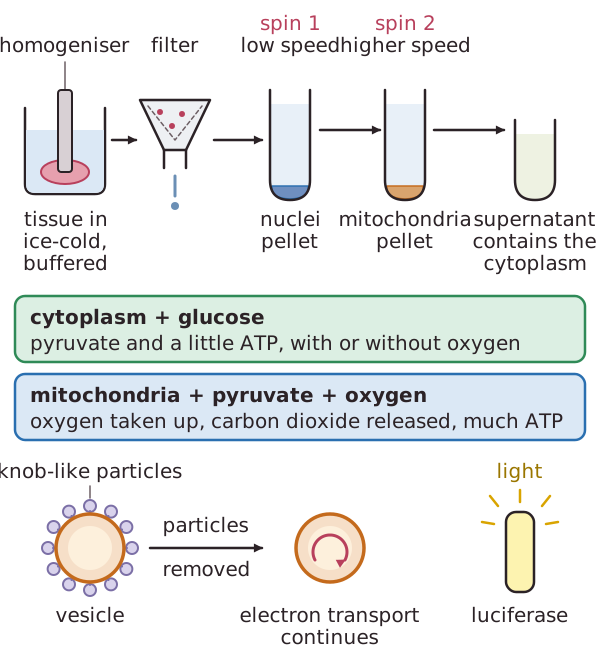 So glycolysis happens in the cytoplasm, and the later stages in mitochondria, which cannot use glucose directly.Further experiments broke mitochondria into fragments of inner membrane, which sealed into small vesicles with knob-like particles on their surface. The vesicles could make ATP. When the particles (ATP synthase) were removed, electron transport continued but no ATP was made, showing that ATP synthase on the cristae is the site of ATP synthesis.ATP can be measured with the firefly enzyme luciferase, which gives out light in proportion to the amount of ATP present.
• Cytoplasm + glucose: pyruvate and a little ATP are made, with or without oxygen.
• Mitochondria + glucose: no oxygen is used and no ATP is made.
• Mitochondria + pyruvate + oxygen: oxygen is taken up, carbon dioxide is released and a large amount of ATP is made.
So glycolysis happens in the cytoplasm, and the later stages in mitochondria, which cannot use glucose directly.Further experiments broke mitochondria into fragments of inner membrane, which sealed into small vesicles with knob-like particles on their surface. The vesicles could make ATP. When the particles (ATP synthase) were removed, electron transport continued but no ATP was made, showing that ATP synthase on the cristae is the site of ATP synthesis.ATP can be measured with the firefly enzyme luciferase, which gives out light in proportion to the amount of ATP present.