The rate of aerobic respiration can be measured with a respirometer, which measures the rate of oxygen uptake by small organisms such as woodlice, maggots or germinating seeds.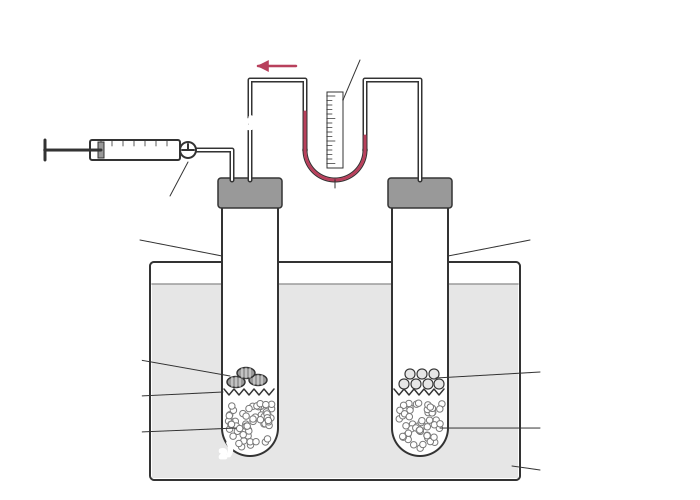
• The organisms sit on a gauze platform above soda lime (or potassium hydroxide solution), which absorbs the carbon dioxide they give out.
• As the organisms take in oxygen, the volume of gas in the tube falls, so a drop of coloured liquid in the capillary tube moves towards the organisms.
• A control tube with glass beads of the same volume as the organisms compensates for changes in temperature and atmospheric pressure.
• The tubes stand in a water bath to keep the temperature constant; a syringe resets the liquid between readings.The volume of oxygen used is found from the distance moved by the liquid:V = πr2h where r is the radius of the capillary bore and h is the distance moved.Worked example: the liquid moves 24 mm in 5 minutes in a capillary of radius 0.5 mm. V = 3.14 × 0.52 × 24 = 18.8 mm3, so the rate is 18.8 ÷ 5 = 3.8 mm3 min−1.To investigate a factor such as temperature, change only that factor, keep the mass of organisms the same, allow time to acclimatise and repeat each reading. For ethical reasons, handle organisms gently, keep them away from the corrosive soda lime and return them to their habitat afterwards.
• The organisms sit on a gauze platform above soda lime (or potassium hydroxide solution), which absorbs the carbon dioxide they give out.
• As the organisms take in oxygen, the volume of gas in the tube falls, so a drop of coloured liquid in the capillary tube moves towards the organisms.
• A control tube with glass beads of the same volume as the organisms compensates for changes in temperature and atmospheric pressure.
• The tubes stand in a water bath to keep the temperature constant; a syringe resets the liquid between readings.The volume of oxygen used is found from the distance moved by the liquid: