Microbiologists often need to know how many cells are in a culture, for example to follow its growth over time. Methods either count the cells directly, or measure something that depends on cell number, such as cloudiness.A total count includes both living and dead cells. A viable count includes only living cells, which can divide.The direct method uses a haemocytometer, a thick microscope slide with an etched grid and a chamber of known depth, usually 0.1 mm. A drop of culture is placed under the coverslip and the cells in chosen squares are counted with a microscope. Because the area of each square and the depth are known, the volume counted is known. Cells touching the top and left edges of a square are counted but not those touching the bottom and right edges, so no cell is counted twice. Adding the stain trypan blue, which is taken up only by dead cells, lets living cells be counted separately.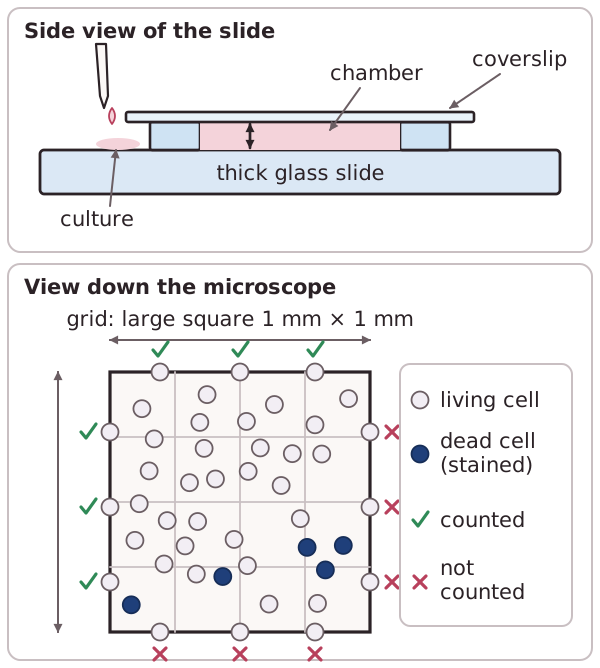 Worked example: 40 cells are counted in a large square of 1 mm × 1 mm, with a depth of 0.1 mm.
volume = 1 × 1 × 0.1 = 0.1 mm3 cells per mm3 = 40 ÷ 0.1 = 400 1 cm3 = 1000 mm3, so there are 4 × 10⁵ cells per cm3. If the culture had been diluted 10 times before counting, multiply by 10.Two other methods, turbidity and dilution plating, are covered in the next lessons.
Worked example: 40 cells are counted in a large square of 1 mm × 1 mm, with a depth of 0.1 mm.