Aseptic technique is a set of procedures that prevents unwanted microorganisms contaminating a culture, and stops the cultured microorganisms escaping and infecting people or the environment.Before starting:
• Wash your hands and wipe the bench with disinfectant.
• Sterilise culture media, Petri dishes and glassware in an autoclave at 121 °C for 15 minutes. The high-pressure steam kills bacteria, fungi and their spores.During inoculation:
• Work close to a lit Bunsen burner. The rising hot air (convection currents) carries airborne microorganisms away from the work.
• Flame a metal inoculating loop until it glows red hot, then let it cool before touching the culture so the microorganisms are not killed.
• Remove the cap of a culture bottle with your little finger and pass the neck of the bottle through the flame, then flame it again before replacing the cap.
• Lift the lid of a Petri dish only slightly and for as short a time as possible.After inoculation:
• Secure the lid with two short strips of tape, not sealed all the way round, so oxygen can enter and harmful anaerobic bacteria are not encouraged.
• Label the base, then incubate the plate upside down so condensation does not drip onto the agar.
• Incubate at no more than 25 °C in school laboratories.Finally, sterilise all used cultures and equipment in an autoclave before disposal, and wash your hands again.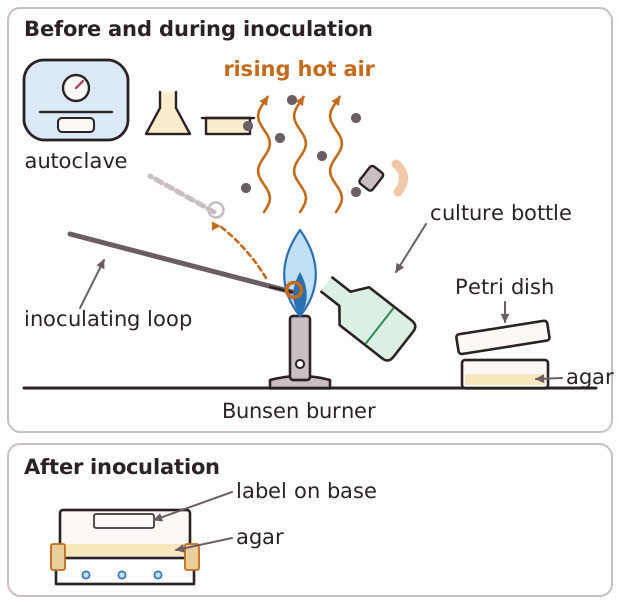
• Wash your hands and wipe the bench with disinfectant.
• Sterilise culture media, Petri dishes and glassware in an autoclave at 121 °C for 15 minutes. The high-pressure steam kills bacteria, fungi and their spores.During inoculation:
• Work close to a lit Bunsen burner. The rising hot air (convection currents) carries airborne microorganisms away from the work.
• Flame a metal inoculating loop until it glows red hot, then let it cool before touching the culture so the microorganisms are not killed.
• Remove the cap of a culture bottle with your little finger and pass the neck of the bottle through the flame, then flame it again before replacing the cap.
• Lift the lid of a Petri dish only slightly and for as short a time as possible.After inoculation:
• Secure the lid with two short strips of tape, not sealed all the way round, so oxygen can enter and harmful anaerobic bacteria are not encouraged.
• Label the base, then incubate the plate upside down so condensation does not drip onto the agar.
• Incubate at no more than 25 °C in school laboratories.Finally, sterilise all used cultures and equipment in an autoclave before disposal, and wash your hands again.