 BRAINCAKE
Dilution Plating
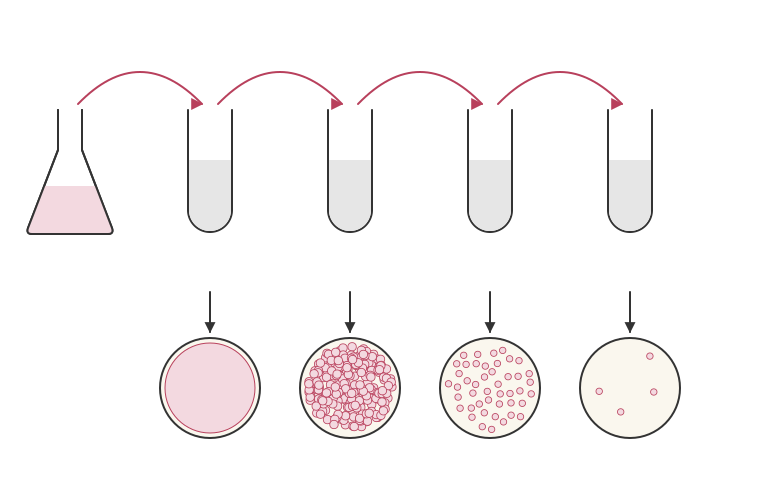
Dilution plating gives a viable count: it counts only cells that are alive and able to divide. A culture usually contains far too many cells to count on one plate, so it is diluted first by serial dilution.
Method:
1. Using aseptic technique, transfer 1 cm3 of culture into 9 cm3 of sterile water and mix. This is a 1 in 10 (10−1) dilution.
2. Transfer 1 cm3 of this into another 9 cm3 of sterile water to give 10−2, and so on, using a fresh sterile pipette each time.
Sign in free to see the rest of this lesson, the R.E.C.I.P.E. recall steps and the quiz
BrainCake is free. Make an account in seconds and pick up where this page stops.
Key terms in this lesson
- serial dilution
- A series of stepwise dilutions, each by the same factor, used to reduce a suspension of cells or a solution to a countable or usable concentration.
More in Bacteria and Disease
- Selective Media
- Growing a Pure Culture
- Counting the Number of Cells
- Turbidity
- Area and Mass of Fungi
- Growth of Bacterial Colonies
- Logarithmic Scale
- Exponential Growth
All 30 lessons in Bacteria and Disease · All Edexcel A-level Biology topics