Skip to content

Growth of Bacterial Colonies

When bacteria are put into fresh nutrient broth in a closed culture (no nutrients added and no waste removed), the population follows a typical growth curve with four phases.
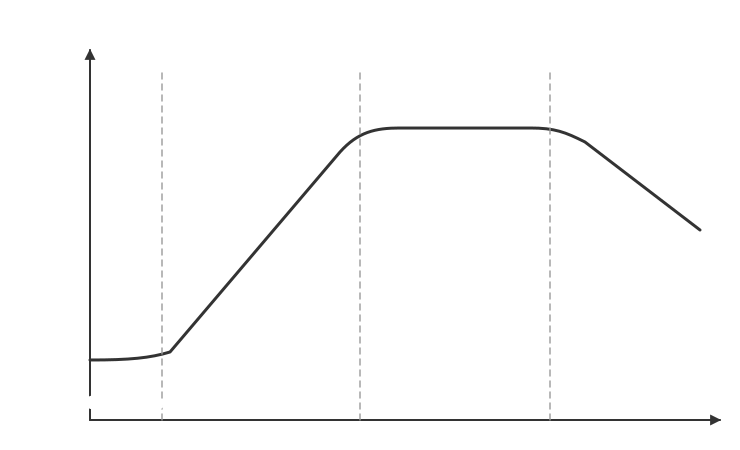
1. Lag phase. The number of cells hardly increases. The bacteria are adjusting to the new conditions: taking up water, and synthesising the enzymes and other molecules needed to use the nutrients available.2. Log (exponential) phase. Cells divide by binary fission at their fastest rate. Nutrients are plentiful and there is little waste, so the number of cells doubles every generation time.3. Stationary phase. The number of cells stays roughly constant because the rate of cell division equals the rate of cell death. Nutrients are running out and toxic waste products, such as acids, are building up. Oxygen may also become limiting.4. Death (decline) phase. Nutrients are exhausted and waste has reached toxic levels, so cells die faster than new cells are produced. The number of living cells falls.The curve shows the number of living cells, as measured by a viable count. A total count such as turbidity falls much less in the death phase, because dead cells still make the broth cloudy.The length of each phase depends on conditions. A higher temperature, up to the optimum, shortens the generation time and makes the log phase steeper. A richer medium lets the population reach a higher level before the stationary phase.

Read the text

Read the text and highlight anything you think is important. When you go on, the text is hidden and you answer from memory.

Specification: Edexcel Biology B (9BI0), A-level, 6.1 Microbial techniques. Topic: Bacteria and Disease.

Key terms in this lesson

binary fission
Asexual reproduction in bacteria in which one cell divides into two genetically identical daughter cells.
generation time
The time taken for a population of cells to double in number under given conditions.

More in Bacteria and Disease

All 30 lessons in Bacteria and Disease · All Edexcel A-level Biology topics