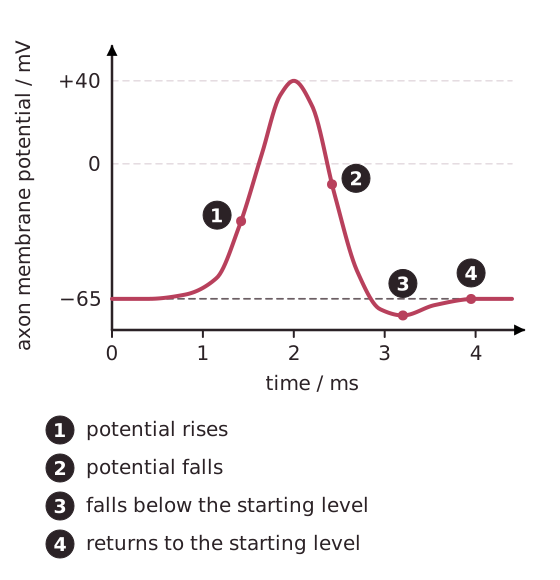
After depolarisation the inside of the axon membrane is at about +40 mV. At this point the voltage-gated sodium ion channels close, so no more Na+ ions can diffuse into the axon.At the same time the voltage-gated potassium ion channels open. The membrane becomes much more permeable to K+ ions, which diffuse out of the axon down their electrochemical gradient. The inside of the axon is positively charged and has a high concentration of K+, so both the concentration gradient and the repulsion between positive charges move K+ outwards.As positive ions leave, the potential difference across the membrane falls back towards a negative value. This return of the membrane potential towards the resting potential is called repolarisation.Repolarisation is the falling phase on a trace of an action potential. The sodium ions cannot follow the potassium ions out, because the sodium channels are closed. The potassium channels are slow to close, which leads to the overshoot described in the next stage.