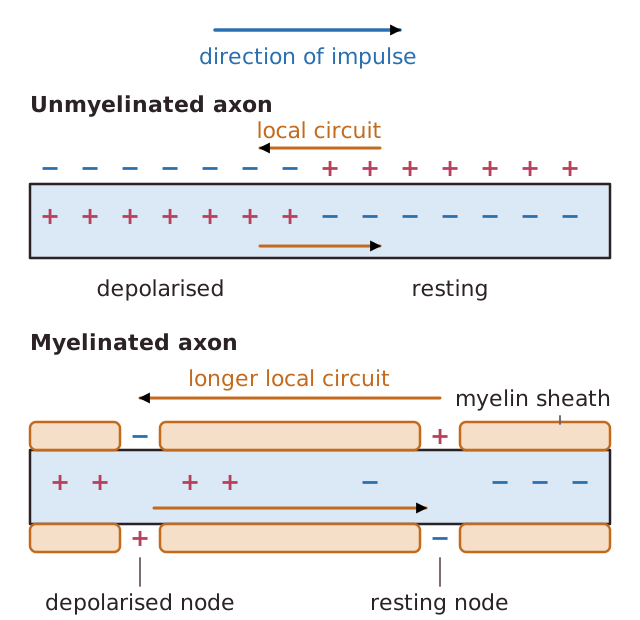
A nerve impulse is an action potential that starts at one end of the neurone and is propagated along the axon to the other end of the neurone.When a region of the membrane is depolarised, the sodium ions that have entered the cell are attracted to the negatively charged area further along the axon and diffuse sideways, triggering the depolarisation of the membrane.Behind this new region of depolarisation the sodium voltage-gated channels close and it is repolarised as potassium ions diffuse out of the axon.The sideways diffusion of sodium ions continues forward along the membrane. Thus localised electrical circuits are set up along the membrane.