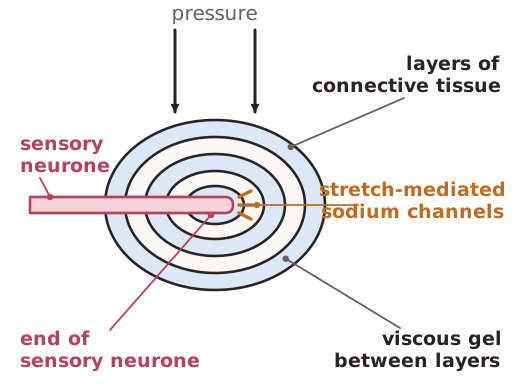
Normally, the sensory neurone is at its resting potential. The axon membrane is negative on the inside.When pressure is applied to the Pacinian corpuscle, the membrane of the neurone stretches and a stretch-mediated sodium ion channel changes shape and widens to allow the diffusion of sodium ions into the neurone.The potential of the neurone changes and it becomes depolarised resulting in a generator potential which then creates an action potential (electrical impulse) that passes along the neurone.
Generator Potential
Read the text
Read the text and highlight anything you think is important. When you go on, the text is hidden and you answer from memory.
Specification: AQA Biology (7402), A-level, 3.6.1.2 Receptors. Topic: Neuronal Communication.
Key terms in this lesson
- rubp
- Ribulose bisphosphate, the five-carbon molecule that combines with carbon dioxide in the Calvin cycle, in a reaction catalysed by rubisco.
- gp
- Glycerate 3-phosphate, the three-carbon compound formed when RuBP combines with carbon dioxide in the Calvin cycle.
More in Neuronal Communication
- Motor Neurones
- Myelinated Neurones
- Sensory Receptors
- Pacinian Corpuscles
- Resting Potential
- Depolarisation
- Repolarisation
- Hyperpolarisation
All 38 lessons in Neuronal Communication · All AQA A-level Biology topics