The temporary reversal of the charge across the axon membrane is called the action potential. The protein channels change shape in response to a change in voltage across the membrane and selectively allow either sodium or potassium ions to diffuse through. The membrane changes from its resting potential to being depolarised and then repolarised, hyperpolarised (the refractory period) and then the resting potential is restored.
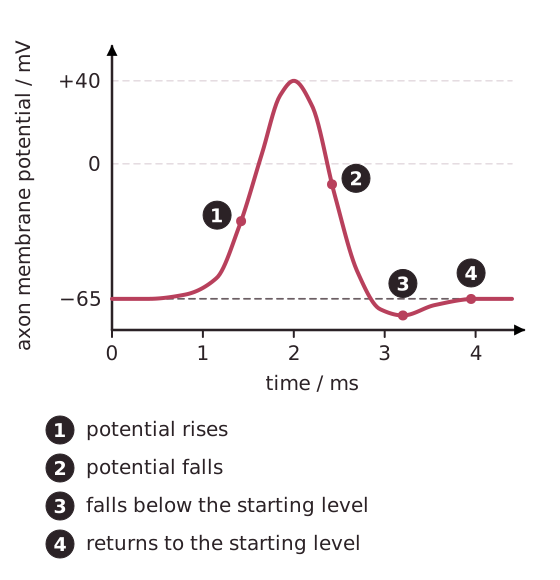
The Action Potential
Read the text
Read the text and highlight anything you think is important. When you go on, the text is hidden and you answer from memory.
Specification: AQA Biology (7402), A-level, 3.6.2.1 Nerve impulses. Topic: Neuronal Communication.
Key terms in this lesson
- photosynthometer
- Apparatus used to measure the rate of photosynthesis in an aquatic plant by collecting the oxygen it releases as a gas bubble in a capillary tube.
More in Neuronal Communication
- Resting Potential
- Depolarisation
- Repolarisation
- Hyperpolarisation
- Nerve Impulse
- Saltatory Conduction
- Synapses
- Neurotransmitters
All 38 lessons in Neuronal Communication · All AQA A-level Biology topics