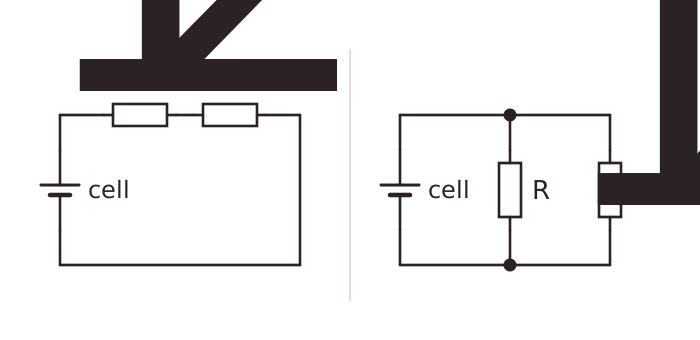
When two resistors are connected in series, there is only one path. The charge has to pass through each resistor in turn, so each one opposes the flow. The total resistance is greater than either resistor on its own. For the same cell, the current is smaller. Adding more resistors in series increases the resistance further.
When two resistors are connected in parallel, the charge has a choice of paths. Each branch is connected directly across the cell, so each one carries its own current, and the cell supplies the sum of these currents. For the same p.d., the cell supplies more current in total, so the total resistance is less. The total resistance of resistors in parallel is always less than the smallest single resistor.
This can be shown with bulbs. Two identical bulbs in series with a cell are each dimmer than a single bulb, because the current is smaller. Two identical bulbs in parallel are each as bright as a single bulb on the same cell, because each has the full p.d. of the cell, although the cell supplies more current in total.