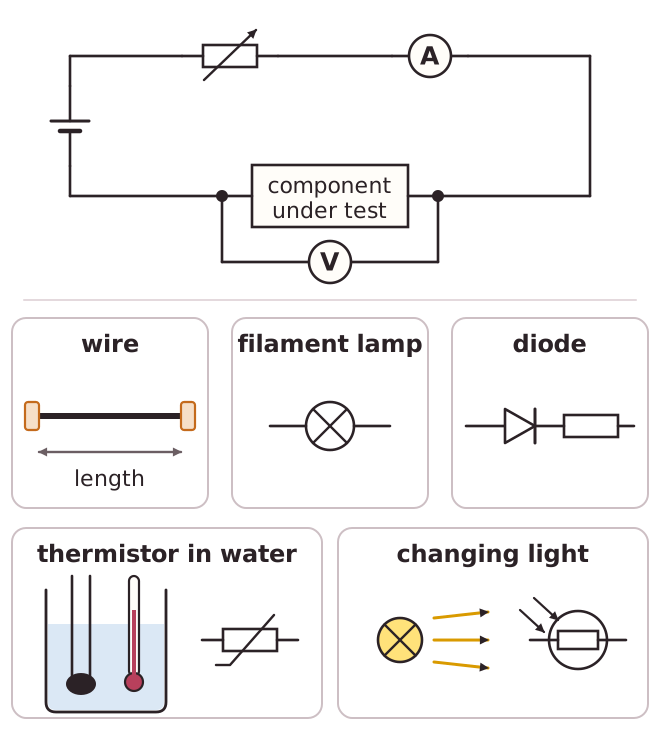
To explore how a component behaves, connect it in series with an ammeter and a variable resistor, and connect a voltmeter in parallel with the component. The variable resistor changes the p.d. across the component. For each setting record the current and the p.d., then calculate the resistance by dividing the potential difference by the current. Repeat readings to improve reliability. For example, 4 V across a wire with 0.5 A through it gives a resistance of 4 ÷ 0.5 = 8 ohms.
For a wire of varying length, keep the current small so the wire does not heat up and its temperature stays constant. A longer wire has a greater resistance, so doubling the length at constant temperature increases the resistance, because electrons collide with more ions on the way through. For a filament lamp the resistance rises as the readings are taken at higher current, because the filament gets hotter.
To test a diode, connect it in both directions to see that current flows in only one, and put a protective resistor in series to limit the current. To test an NTC thermistor, place it in a beaker of water, heat the water and record the temperature with each pair of readings. Its resistance decreases as the temperature rises. To test an LDR, change the light intensity and record the readings. Its resistance decreases as the light gets brighter.