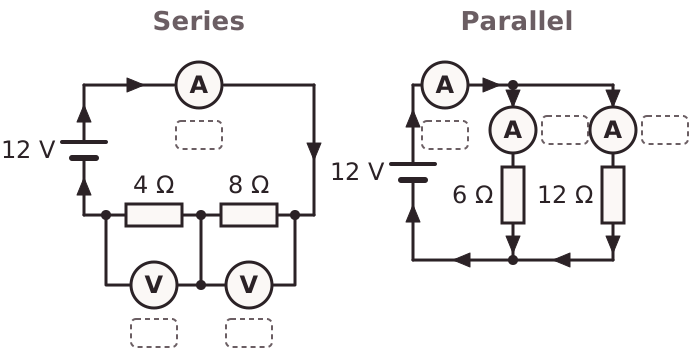
Use potential difference = current × resistance (V = I × R) for the whole circuit or for any single component. For a component such as a thermistor or an LDR, read its resistance from the data given for the temperature or light level, then use the same equation.
Series circuits. The current is the same everywhere. The p.d.s across the components add up to the p.d. of the cell, and the total resistance is the sum of the resistances. A 4 ohm and an 8 ohm resistor in series have a total resistance of 12 ohms. On a 12 V cell the current is 12 ÷ 12 = 1 A, so the p.d. across the 8 ohm resistor is 1 × 8 = 8 V and across the 4 ohm resistor it is 4 V.
Parallel circuits. The p.d. across each branch is the same as the p.d. of the cell, and the branch currents add up to the total current. A 6 ohm and a 12 ohm resistor are each connected across a 12 V cell. The current in the 6 ohm branch is 12 ÷ 6 = 2 A and in the 12 ohm branch it is 12 ÷ 12 = 1 A. The total current is 3 A, so the total resistance is 12 ÷ 3 = 4 ohms, which is less than the smaller resistor.