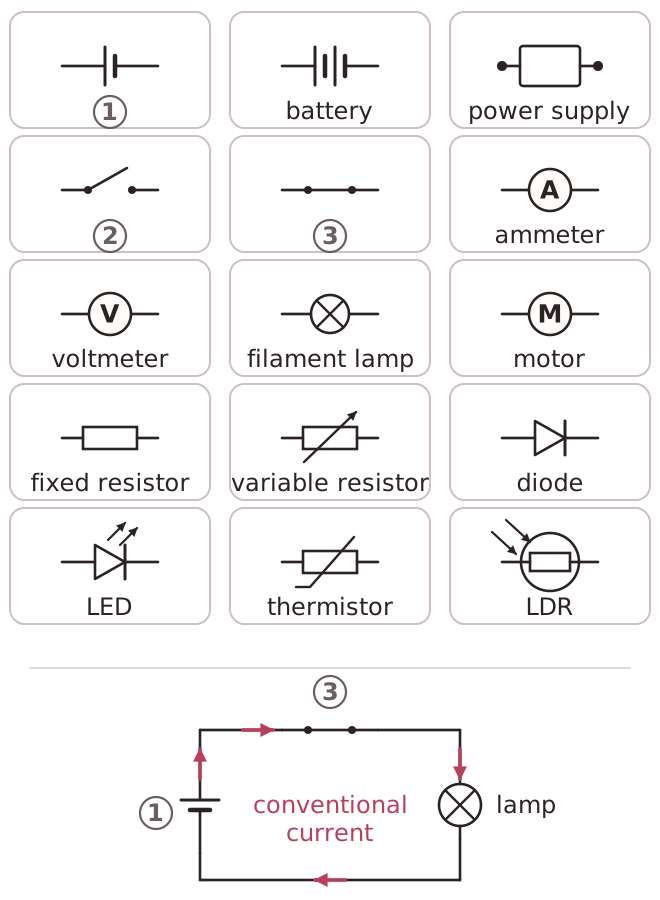
A circuit diagram uses standard symbols so that anyone can read it and build the circuit. A cell is drawn as two parallel lines, one long and one short. The longer line is the positive terminal and the shorter, thicker line is the negative terminal. A battery is two or more cells joined together. A power supply has its own symbol and also has a positive and a negative terminal.
In a d.c. circuit the current always flows in one direction. Conventional current is drawn flowing from the positive terminal of the supply, round the circuit, to the negative terminal. An ammeter is a circle containing the letter A and a voltmeter is a circle containing the letter V. A switch is drawn as a gap in the wire with a lever that can close it.
A fixed resistor is drawn as a rectangle. A variable resistor is a rectangle with an arrow through it. A filament lamp is a circle containing a cross. A diode is a triangle with a bar across its point, and it lets current through only in the direction the triangle points. If the triangle points to the right, current can flow to the right but not to the left. An LDR is a resistor in a circle with arrows pointing towards it to show light falling on it, and a thermistor is a resistor drawn with a line through it that shows it responds to temperature.